Reviewed by Dr. Ladan Eshkevari, PhD, CRNA, FAAN — lead clinician at Avesta Ketamine & Wellness and a longtime researcher in physiology, biophysics, and anesthesiology.
Ketamine has undergone one of the most remarkable transformations in modern medicine — from a 1960s battlefield anesthetic, through a recreational drug, to one of the most promising treatments for depression, PTSD, and chronic pain in decades. This article traces ketamine’s 60-year journey through psychiatric medicine, from its synthesis in 1962 to the FDA’s 2019 approval of Spravato (esketamine) for treatment-resistant depression.
When Was Ketamine First Discovered?
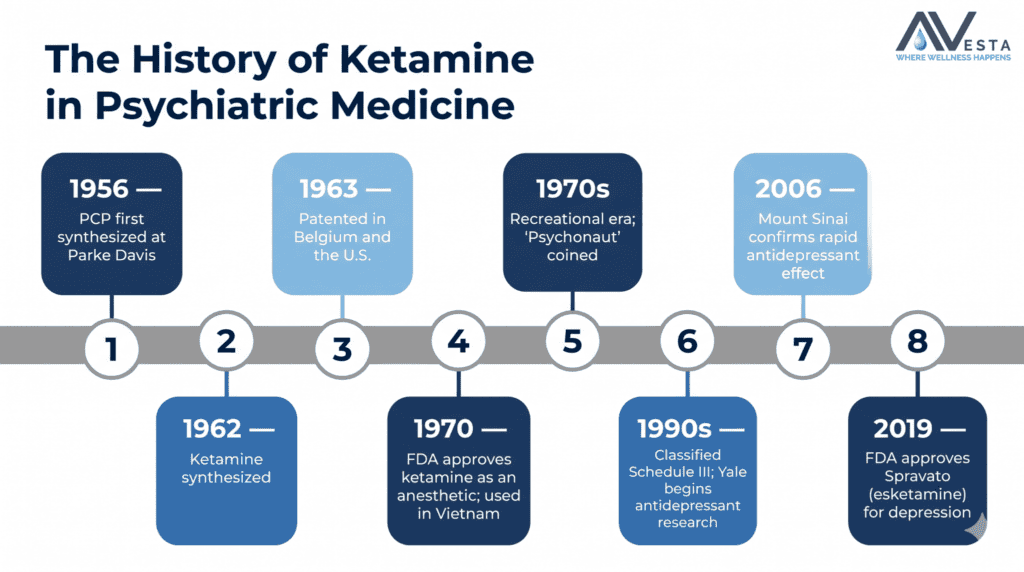
Ketamine’s story begins not with ketamine itself, but with its chemical predecessor: phencyclidine (PCP). PCP was first synthesized in 1956 by chemists at the Parke Davis Company, who quickly discovered its unique pharmacology[1]. However, PCP also produced disturbing psychotic side effects in patients, sometimes lasting hours after a procedure.
Looking for a shorter-acting, less unsettling alternative, Parke Davis chemist Calvin Stevens synthesized ketamine in 1962[2]. It produced fewer psychiatric after-effects and wore off more quickly than PCP. The compound was patented in Belgium in 1963 and shortly after in the United States.
FDA Approval as an Anesthetic (1970)
In 1970, the U.S. Food and Drug Administration approved ketamine as a human anesthetic[3]. The timing was critical: the Vietnam War was at its height, and military medics needed a fast-acting anesthetic they could administer in the field — without an operating room, anesthesiologist, or extensive monitoring equipment. Ketamine’s safety profile made it ideal for battlefield use.
Today, ketamine remains on the World Health Organization’s List of Essential Medicines and is administered via intravenous, intramuscular, oral, nasal, and intraosseous routes[4].
The Recreational Era and the “Psychonauts” (1970s)
By the early 1970s, ketamine had migrated from operating rooms to the street. It first appeared in the U.S. recreational drug market on the West Coast in 1971[5]. The same cultural moment that produced widespread interest in LSD and psilocybin embraced ketamine — sometimes marketed under names like “Special K,” “Vitamin K,” or “Kit-Kat.”
German writer Ernst Jünger coined the term “Psychonaut” in 1970 to describe those who used psychedelic drugs to “seek altered states of consciousness to search for truth in the unconscious mind”[6]. Two books in particular brought ketamine into psychedelic literature:
- Journeys into the Bright World (1978) by Marcia Moore and Howard Alltounian — questioned whether ketamine might one day have therapeutic and medicinal benefits[7].
- The Scientist (1978) by John C. Lilly — chronicled Lilly’s experiences as a physician and psychoanalyst using ketamine extensively. Lilly became one of ketamine’s most prominent — and controversial — early advocates.
Moore’s introduction was strikingly prescient: “Why are the ‘mind-manifesting’ drugs still regarded with so much fear? Can it be because modern science still lingers on the threshold of the unconscious, hesitating to knock too loudly for fear of what might be revealed if the door should open?” Five decades later, much of the scientific establishment has finally started knocking.
Schedule III Classification and Early Research (1990s)
As recreational use grew through the 1980s and 1990s, U.S. authorities took action. Ketamine was classified as a Schedule III controlled substance — defined by the DEA as drugs with “low to moderate physical and psychological dependence potential,” lower-risk than Schedule I or II but higher than Schedule IV[8].
At the same time, researchers were beginning to study ketamine’s effects on the human mind in carefully controlled settings. In 1994, Krystal and colleagues at Yale assessed positive and negative symptoms of schizophrenia in healthy subjects given low doses of ketamine[9]. These studies — originally designed to understand psychosis — laid the groundwork for everything that came next.

Ketamine as an Antidepressant Breakthrough (2000–2019)
The pivotal discovery came at Yale in the early 2000s, when researchers asked a different question: could ketamine help treat depression?
What they found was unprecedented. Unlike traditional antidepressants, which can take weeks to produce results, ketamine appeared to relieve depressive symptoms within hours. Researchers learned that ketamine triggers the production of glutamate, which prompts the brain to form new neural connections — making the brain more adaptable and helping patients develop more positive thought patterns[10].
Skepticism was understandable. Dennis Charney, dean of the Icahn School of Medicine at Mount Sinai, set out to replicate Yale’s findings with a larger group of patients. Results published in 2006 confirmed what Yale had seen: ketamine could produce rapid antidepressant effects that traditional medications could not match[11].
The breakthrough moment for the wider public came on March 5, 2019, when the FDA approved esketamine (Spravato®) — a nasal spray containing the S-form of ketamine — for treatment-resistant depression[12]. Yale chief psychiatrist John Krystal and Stanford psychiatrist Carolyn Rodriguez have called it a “game-changer.” It was the first medication with a novel mechanism approved for major depression in more than three decades.
Ketamine Therapy Today
Today, ketamine therapy is offered in clinical settings across the United States as a treatment for:
- Treatment-resistant depression
- Anxiety
- PTSD
- Obsessive Compulsive Disorder (OCD)
- Bipolar depression
- Substance use disorders
- Chronic pain and CRPS
- Migraines
Two evidence-based options are available: IV ketamine infusions and Spravato (esketamine) nasal spray — both administered under clinical supervision. Many patients also benefit from ketamine-assisted psychotherapy (KAP), which combines treatment with structured psychological support.
Demand has only grown since the COVID-19 era, when researchers writing in the American Journal of Psychiatry noted: “Prioritizing innovative treatments like rapid-onset antidepressant medications to reduce acute suicide risk should be at the top of the national mental health agenda”[13].
Frequently asked questions
When was Ketamine first synthesized?
Ketamine was first synthesized in 1956 by chemists at Parke Davis Company.
What routes are Ketamine administered through?
Ketamine is currently administered via the intravenous, intraosseous, intramuscular, oral, nasal, and rectal routes.
When was Ketamine approved as an anesthetic?
Ketamine was approved as a human anesthetic ten years after its synthesis.
References
- Domino EF, Warner DS. “Taming the Ketamine Tiger.” Anesthesiology, 2010. Accessed May 26, 2026.
- Li L, Vlisides PE. “Ketamine: 50 Years of Modulating the Mind.” Frontiers in Human Neuroscience, 2016. Accessed May 26, 2026.
- Rogers K. “Ketamine.” Encyclopedia Britannica, 2022. Accessed May 26, 2026.
- Marland S, Ellerton J, Andolfatto G, et al. “Ketamine: Use in Anesthesia.” CNS Neuroscience & Therapeutics, 2013. Accessed May 26, 2026.
- World Health Organization Expert Committee on Drug Dependence. “Ketamine — Critical Review Report.” WHO. Accessed May 26, 2026.
- Haenfler R. “Psychonauts.” Grinnell College Subcultures and Sociology. Accessed May 26, 2026.
- Moore M, Alltounian H. “Journeys into the Bright World.” Para Research Inc, 1978. Accessed May 26, 2026.
- U.S. Drug Enforcement Administration. “Drug Scheduling.” DEA. Accessed May 26, 2026.
- Krystal JH, Karper LP, Seibyl JP, et al. “Subanesthetic Effects of the Noncompetitive NMDA Antagonist, Ketamine, in Humans.” Archives of General Psychiatry, 1994;51(3):199–214. Accessed May 26, 2026.
- Chen J. “How Ketamine Drug Helps With Depression.” Yale Medicine, 2022. Accessed May 26, 2026.
- Torrice M. “Ketamine Is Revolutionizing Antidepressant Research, But We Still Don’t Know How It Works.” Chemical & Engineering News, 2020. Accessed May 26, 2026.
- U.S. Food and Drug Administration. “FDA Approves New Nasal Spray Medication for Treatment-Resistant Depression; Available Only at a Certified Doctor’s Office or Clinic.” FDA, March 5, 2019. Accessed May 26, 2026.
- Parikh T, Walkup JT. “The Future of Ketamine in the Treatment of Teen Depression.” American Journal of Psychiatry, 2021. Accessed May 26, 2026.