
VA ketamine treatment is covered, and you do not have to receive it inside a VA hospital. Through community care, Hampton VA and Richmond VA authorize and pay for IV ketamine for treatment-resistant depression. We deliver that care locally through our ketamine program for Hampton Roads veterans. Authorized veterans are not billed by us, and many pay nothing at all.
What is VA community care?
Community care is the VA paying an outside clinic to treat you when it cannot deliver the care itself. If the service you need is not offered at your VA facility, or you cannot get an appointment within the VA’s drive-time and wait-time standards, the VA can authorize a community provider and cover the cost.[2] You stay a VA patient the whole time. Your records flow back to your VA care team.
We are an authorized community care provider for Hampton VA and Richmond VA. When a care coordinator at either facility refers a veteran to us, the VA pays. The veteran does not.
Most eligible veterans in Hampton Roads have never been told this option exists. That is the reason this article exists.
Does the VA cover ketamine treatment?
Yes, with specifics that matter.
What the VA covers
The VA’s clinical determination for IV ketamine, CDI 00030, lists two covered indications: treatment-resistant depression and depression with severe suicidal ideation.[1] Treatment-resistant depression (TRD) means depression that has not responded to at least two adequate medication trials. The VA applies its own, stricter coverage bar on top of that definition, covered in the eligibility section below. For any condition outside those two indications, the VA currently considers IV ketamine not medically necessary.
Spravato (esketamine), the nasal spray derived from ketamine, carries FDA approval for treatment-resistant depression (March 2019) and for depressive symptoms in adults with major depressive disorder with acute suicidal ideation or behavior (August 2020).[3][4] We offer both IV ketamine and Spravato in our clinics.
What about PTSD?
The honest answer, which some clinics blur: the VA does not cover IV ketamine for PTSD, and Spravato is not FDA-approved for PTSD.[1]
PTSD rarely travels alone, though. Many veterans carrying a PTSD diagnosis also meet the criteria for treatment-resistant depression, and that diagnosis is the route to VA-covered care. If you have both, you may qualify. Our free consultation screens for exactly this before you ever ask your VA for a referral.
Who qualifies: VA community care eligibility
Two doors need to open, one clinical and one administrative.
The clinical door is the VA’s own criteria for IV ketamine.[1] In plain language: a diagnosis of major depressive disorder; either no full response after four adequate antidepressant trials from different classes (including augmentation or psychotherapy where appropriate) or severe suicidal depression where a rapid response matters; a PHQ-9 score of 15 or higher within the past 30 days (or an equivalent severity measure); and consideration of ECT as an option where appropriate.
The administrative door is community care itself. You need to be enrolled in VA health care and meet at least one eligibility trigger, such as the service not being available at your facility or appointments falling outside the VA’s access standards.[2]
Final say on authorization rests with the community care office. We cannot promise it, and no outside clinic honestly can. What we can do is help you understand whether your history fits the criteria before you start the process.
How to get a VA community care referral for ketamine treatment
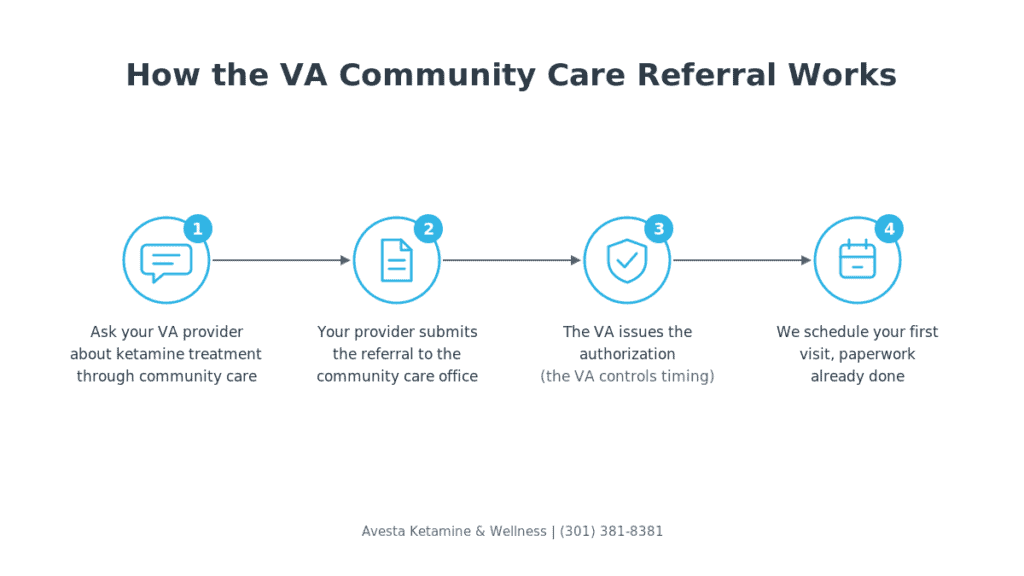
- Tell your VA mental health provider or primary care provider that you want to be evaluated for ketamine treatment through community care. Name it plainly; the option is real and they can act on it.
- Your provider submits the referral request to your facility’s community care office.
- The community care office reviews eligibility and issues the authorization. Your VA care coordinator handles this step. Timing varies by facility and is the VA’s to control, not ours.
- We take it from there. Our team completes the paperwork before your first visit and coordinates with your VA care team throughout treatment.
You will not get a bill from us for authorized care. The VA pays us directly, and any copay follows the same rules as care inside the VA; many veterans qualify for no copay at all.
What treatment looks like at our Norfolk clinic

We have provided monitored, in-clinic ketamine care since 2018. Treatment is physician-led, and our protocols follow the 2018 multi-society consensus guidelines on IV ketamine infusion from ASRA, AAPM, and ASA, guidelines our founder, Dr. Ladan Eshkevari, helped develop.
A typical infusion visit at our Norfolk clinic runs about two hours. Vitals and a brief mood assessment come first, the infusion itself takes roughly 40 minutes with your blood pressure and comfort monitored the entire time, and you rest in recovery until your ride takes you home.
Does it work? In the 2006 NIH trial that opened the modern era of ketamine research, 71% of participants with treatment-resistant depression responded within a day of a single infusion.[5] That was a small study of 18 people, so hold the number loosely. In our own outcome tracking across mood disorders, 68 to 70% of patients respond to a full course. Some patients do not respond, and we say so up front. Ketamine is a fit for specific clinical profiles, and we screen carefully rather than treat everyone who calls. Veterans at every one of our locations can start with our veterans program page.
What if you have TRICARE instead?
TRICARE covers Spravato for treatment-resistant depression and for major depressive disorder with suicidal ideation, with prior authorization required.[7] We are not currently in network with TRICARE, so a TRICARE referral does not reach us directly.
That leaves two routes. If you are also enrolled in VA health care, a community care referral works exactly as described above, and the VA pays. If not, we offer self-pay treatment with transparent pricing and financing options, and our guide to VA coverage for ketamine therapy walks through the benefits side in more detail.
Frequently asked questions
Does the VA cover Spravato?
The VA covers Spravato (esketamine) consistent with its FDA approvals: treatment-resistant depression and depressive symptoms in adults with major depressive disorder with acute suicidal ideation or behavior. It is not approved for PTSD. Whether Spravato or IV ketamine fits your situation is a clinical decision your VA team and our providers make together.
Is VA community care being discontinued?
No. The VA is replacing the administrative contracts behind community care in 2026 and consolidating its regions, which changes who processes claims, not whether veterans can use the benefit. Referrals and authorizations continue.
Will I pay anything out of pocket?
For authorized community care, the VA pays us directly and you will not receive a bill from our clinic. Copays follow the same VA rules that apply inside a VA facility, and many veterans, particularly those with service-connected conditions, qualify for no copay at all.
How long does authorization take?
Authorization timing belongs to the VA and varies by facility, so we do not quote a turnaround. Once your authorization lands, our paperwork is already done and we schedule your first visit without delay.
I have PTSD but no depression diagnosis. What are my options?
Start with a free consultation, because many veterans with PTSD also meet the criteria for treatment-resistant depression. If you do, that is a path to VA-covered care. If not, options include PTSD care inside the VA and self-pay ketamine treatment with us.
References
- VHA Office of Integrated Veteran Care. Clinical Determination and Indication: Intravenous Ketamine for Treatment Resistant Depression, CDI 00030. U.S. Department of Veterans Affairs. https://www.va.gov/COMMUNITYCARE/docs/providers/CDI/IVC-CDI-00030.pdf Accessed July 21, 2026.
- U.S. Department of Veterans Affairs. Veteran Care Overview, Community Care. https://www.va.gov/COMMUNITYCARE/programs/veterans/index.asp Accessed July 21, 2026.
- U.S. Food and Drug Administration. FDA approves new nasal spray medication for treatment-resistant depression; available only at a certified doctor’s office or clinic. March 5, 2019. https://www.fda.gov/news-events/press-announcements/fda-approves-new-nasal-spray-medication-treatment-resistant-depression-available-only-certified Accessed July 21, 2026.
- Johnson & Johnson (Janssen). Janssen Announces U.S. FDA Approval of Spravato (esketamine) CIII Nasal Spray to Treat Depressive Symptoms in Adults with Major Depressive Disorder with Acute Suicidal Ideation or Behavior. August 2020. https://www.jnj.com/media-center/press-releases/janssen-announces-u-s-fda-approval-of-spravato-esketamine-ciii-nasal-spray-to-treat-depressive-symptoms-in-adults-with-major-depressive-disorder-with-acute-suicidal-ideation-or-behavior Accessed July 21, 2026.
- Zarate CA Jr, et al. A randomized trial of an N-methyl-D-aspartate antagonist in treatment-resistant major depression. Archives of General Psychiatry. 2006;63(8):856-864. PMID 16894061. https://pubmed.ncbi.nlm.nih.gov/16894061/ Accessed July 21, 2026.
- U.S. Department of Veterans Affairs. VA to improve health care choice and quality for Veterans with new community care contracts. VA News. https://news.va.gov/press-room/va-to-improve-health-care-choice-and-quality-for-veterans-with-new-community-care-contracts/ Accessed July 21, 2026.
- TRICARE / TriWest Healthcare Alliance. Behavioral Health Coverage and Requirements. June 10, 2025. https://tricare.triwest.com/globalassets/tricare/provider/tricare-behavioral-health-coverage-and-requirements.pdf Accessed July 21, 2026.