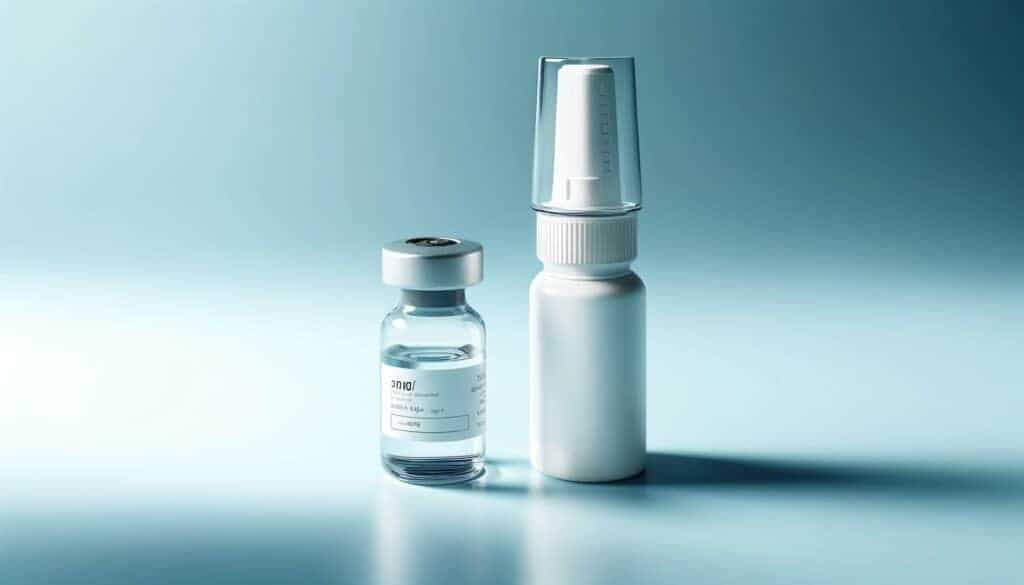
Esketamine and ketamine are closely related but not identical. Ketamine is a racemic mixture of two mirror-image molecules: R-ketamine and S-ketamine. Esketamine is just the S-ketamine half.[1] Esketamine is FDA-approved for treatment-resistant depression and sold as the nasal spray Spravato.[3] Generic ketamine is FDA-approved as an anesthetic and used off-label, typically as an IV infusion, to treat depression and chronic pain.
| Factor | Esketamine (Spravato) | Ketamine (IV infusion) |
|---|---|---|
| Chemical form | S-enantiomer only | Racemic (R + S enantiomers) |
| FDA approval | Approved for treatment-resistant depression (2019); the current label also covers depressive symptoms in adults with major depressive disorder with acute suicidal ideation or behavior, and use without an oral antidepressant[3] | Approved as an anesthetic; used off-label for depression |
| Route | Nasal spray, self-administered under supervision | IV infusion, clinician-administered |
| Session length | About 2 hours, including the required monitoring period[3] | 45 to 60 minutes |
| Typical schedule | Twice weekly for 4 weeks, then weekly or every other week[3] | 6 infusions over 2 to 3 weeks, then maintenance |
| Insurance coverage | Usually covered after two failed antidepressants, with prior authorization | The medication itself is rarely covered because it is off-label. Some clinics, including ours, are in-network and bill the visit, monitoring, and management portions |
| Typical out-of-pocket cost | As little as $0 to $10 per session for approved patients using the manufacturer savings program[9] | $300 to $2,000 per session nationally. At our clinics, self-pay is $450 per session, or $425 per session in a six-session package |
| Approved for ages | Adults 18 and older only[3] | Primarily adults. We do treat select patients under 18, never as a first-line option and only in coordination with their psychiatrist and therapist |
| Other uses | Treatment-resistant depression and MDD with acute suicidal ideation or behavior[3] | PTSD, OCD, anxiety, chronic pain, substance use disorder |
A note for parents: Spravato is approved for adults 18 and older only. Racemic ketamine is used primarily in adults, and we do treat select patients under 18. It is not a first-line option for a young person, and we will want to coordinate with their psychiatrist and therapist before starting. If you are considering it for your child, start with a consultation so we can review their history together.
How is Esketamine / Spravato Different from Ketamine?

Esketamine is one half of the ketamine molecule. Ketamine is a racemic mixture of two mirror-image molecules, R-ketamine (arketamine) and S-ketamine. Esketamine is the S-ketamine half isolated and sold as the nasal spray Spravato. S-ketamine binds NMDA receptors about four times more tightly than R-ketamine, with inhibition constants of 0.30 micromolar against 1.4 micromolar.[1][2] Animal research suggests the weaker-binding R-ketamine may produce antidepressant effects that are as strong or longer lasting, with less dissociation, though that has not been confirmed in humans.[4][5] We cover the two halves in more detail in our guide to S-ketamine versus R-ketamine.
How are Esketamine / Spravato and Ketamine Similar?
Esketamine and ketamine share the same mechanism of action and produce similar effects in the brain. Both activate glutamate-related NMDA receptors, which supports neuroplasticity, the brain's ability to rewire and adapt.[1] Both produce dissociative effects during dosing, with patients reporting altered perceptions and a feeling of detachment from their surroundings.[7] Both can deliver rapid antidepressant relief, often within hours, compared with the weeks required by traditional SSRI antidepressants.[11]
How Esketamine / Spravato vs Ketamine Is Administered
Esketamine is given as a nasal spray; ketamine is given as an IV infusion. Both must be administered in a monitored clinical setting. Spravato sessions involve 2 to 3 nasal doses spaced 5 minutes apart, followed by about 2 hours of monitoring, typically twice weekly for 4 weeks, then weekly or every other week during maintenance.[3] IV ketamine is delivered through a vein over 45 to 60 minutes, usually as 6 infusions across 2 to 3 weeks with booster sessions as needed.
Intranasal Spravato is administered through the nose, twice weekly
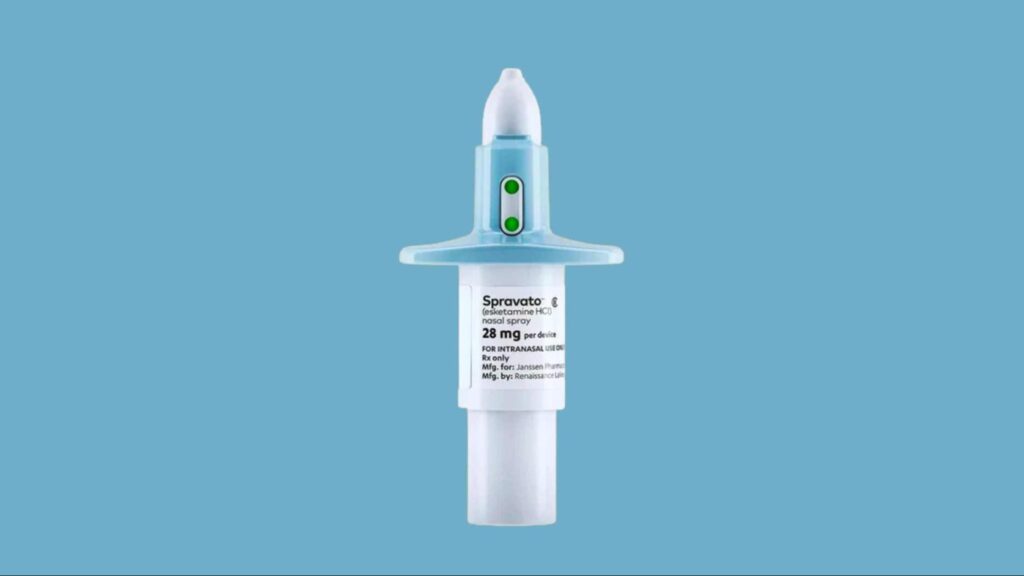
Spravato delivers a low esketamine dose through the nose in a quick burst. Most patients receive two to three doses about five minutes apart, using them twice weekly for the first four weeks and once every week or two in the maintenance phase. Each session requires about two hours of monitoring after administration, and side effects can last a few hours.[3]
IV Ketamine is administered through the vein
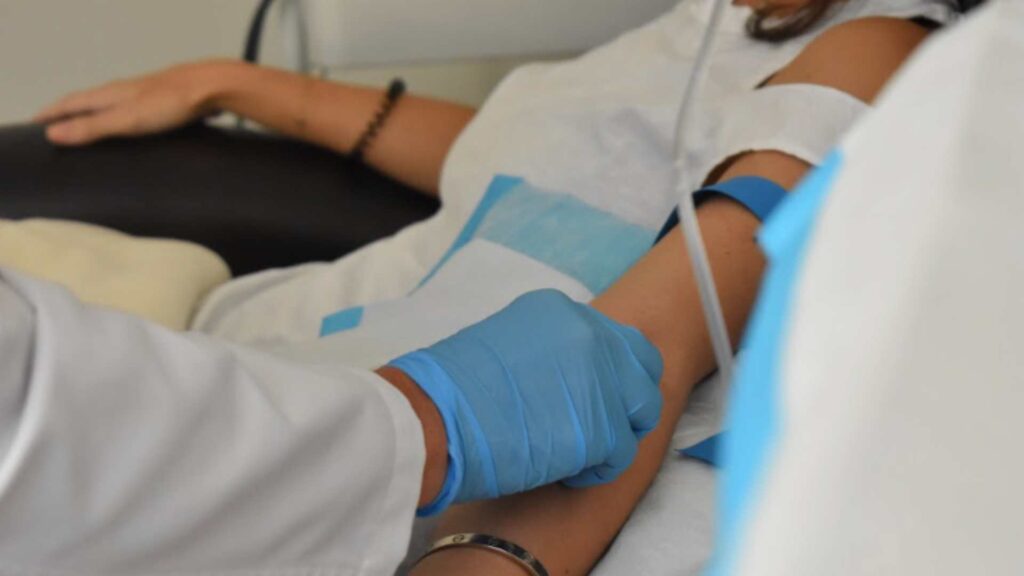
IV ketamine infusions are administered through the vein and directly into the bloodstream under controlled doses via an IV line. Most patients receive six treatments over two to three weeks, with maintenance and booster sessions for those who need them. Sessions last 45 minutes to an hour, and side effects can linger for several hours post-infusion.
We offer both protocols at our Bethesda, MD, Washington, DC, Tysons, VA, Columbia, MD, and Norfolk, VA clinics.
Esketamine / Spravato vs Ketamine: Side Effects Compared
Esketamine and ketamine produce closely similar short-term side effects. Both can cause dissociation (a sense of detachment from reality), disorientation, nausea or vomiting, and anxiety during the session.[3] The evidence on which form is easier to tolerate is mixed. An older volunteer study found less drowsiness and cognitive impairment with S-ketamine than with equianalgesic racemic ketamine,[6] while a later randomized volunteer trial found no significant difference between the two and reported that S-ketamine produced a somewhat more negatively experienced altered state.[7] Side effects from both typically resolve within a few hours, and serious adverse events are rare when the medicine is administered in a supervised clinical setting.[3]
Esketamine / Spravato vs Ketamine: Cost Comparison
With insurance, esketamine is usually cheaper; without insurance, IV ketamine is usually cheaper. Spravato is FDA-approved for treatment-resistant depression, so most insurance plans cover it after a patient has failed two prior antidepressants, and approved patients using the manufacturer savings program can pay as little as $0 to $10 per session.[9] IV ketamine is off-label for depression, so the medication itself is rarely covered, and self-pay rates run roughly $300 to $2,000 per session nationally. The American Society of Ketamine Physicians, Psychotherapists and Practitioners considers $400 to $800 per treatment a reasonable range.[8]
Our own pricing sits inside that range: $450 per IV session self-pay, or $425 per session in a six-session package. We are also in-network for IV ketamine with Cigna and the VA and bill United Healthcare, UMR, Kaiser, and Aetna on your behalf, which is how insured patients can pay as little as $0 to $150 per visit in co-pays. For the full breakdown by payer, see our guide to ketamine therapy costs.
Is Esketamine / Spravato or Ketamine Better for Depression?
Both treatments work. Meta-analyses of the trial evidence favor IV racemic ketamine over intranasal esketamine, but the two have never been compared head to head in a large trial, so the difference should be read as a lean rather than a verdict. The comparisons below pool separate trials of each formulation against placebo or an active control, which is a weaker form of evidence than a direct comparison.[10][11]
Here is what the available research shows:
- Bahji et al. (2021): a systematic review and meta-analysis of 24 randomized trials and 1,877 participants. Against control conditions, racemic ketamine showed a larger response (rate ratio 3.01 against 1.38) and remission advantage (3.70 against 1.47) than esketamine, along with fewer dropouts. The authors also found significant publication bias, and correcting for it reduced the pooled effect sizes substantially.[10]
- Nikolin et al. (2023): the largest analysis to date, covering 49 randomized trials and 3,299 participants. Effect sizes for depression severity, response, and remission were numerically greater for racemic ketamine than for esketamine, and effects during repeated dosing and after the final dose stayed significant for racemic ketamine but not for esketamine.[11]
- Correia-Melo et al. (2020): the one randomized, double-blind head-to-head comparison, in 63 adults with treatment-resistant depression. Remission at 24 hours was 24.1% with a single ketamine infusion and 29.4% with a single esketamine infusion, confirming non-inferiority. Both were safe and well tolerated.[12]
- Singh et al. (2022, 2023): a Mayo Clinic real-world comparison of 62 patients. Response (56.3% against 53.3%) and remission rates (39.6% against 26.7%) were similar and not statistically different, but patients reached remission with significantly fewer IV ketamine treatments than intranasal esketamine treatments.[13][14]
- Nikayin et al. (2022): a Yale clinical-practice comparison of 210 patients. The primary outcome, depression score at the end of treatment, did not reach statistical significance (P = .06). Secondary outcomes favored IV ketamine, and there was no difference in response (37.8% against 36.0%) or remission (29.6% against 24.0%) rates.[15]
Read together, the pattern is consistent: IV ketamine tends to look modestly better on symptom scores and needs fewer sessions to reach remission, while response and remission rates themselves come out close to even. Which one is right for you depends more on your coverage, your diagnosis, and your tolerance for an IV than on the size of that gap.
Does Esketamine / Spravato Work for Pain Like Ketamine?
No. Esketamine is not approved or used for pain, while IV ketamine has substantial evidence in acute and chronic pain.
- A 2019 systematic review and meta-analysis of randomized controlled trials found that ketamine infusions provide significant short-term relief in chronic pain.[16]
- A 2014 review of the chronic pain literature reported that low-dose ketamine produces potent analgesia in neuropathic pain states during administration, and that three studies of prolonged infusion (4 to 14 days) showed analgesic effects lasting up to three months afterward.[17]
- The American Society of Hematology 2020 sickle cell disease guidelines suggest a subanesthetic ketamine infusion as an add-on for hospitalized patients whose acute pain is not controlled by opioids alone. This is a conditional recommendation based on very low certainty evidence, not a first-line one.[18]
The Bottom Line: Which Should You Choose?
Choose esketamine (Spravato) if you have insurance, qualify for coverage, and prefer a non-invasive nasal spray. Choose IV ketamine if you are paying out of pocket, need treatment for a condition other than treatment-resistant depression, or want the option with the broader research base for depression and chronic pain. For many of our patients the deciding factor is coverage rather than chemistry, and that is worth checking before you choose.
We offer both protocols at our Bethesda, Washington DC, Tysons, Columbia, and Norfolk locations. Request a consultation and our intake team will walk you through which one fits your plan and your diagnosis.
References
- Jelen LA, Young AH, Stone JM. "Ketamine: A tale of two enantiomers." Journal of Psychopharmacology, 2021;35(2):109-123. PMID 33155503. pmc.ncbi.nlm.nih.gov. Accessed July 31, 2026.
- Ebert B, Mikkelsen S, Thorkildsen C, Borgbjerg FM. "Norketamine, the main metabolite of ketamine, is a non-competitive NMDA receptor antagonist in the rat cortex and spinal cord." European Journal of Pharmacology, 1997;333(1):99-104. Inhibition constants: (S)-ketamine 0.30 micromolar, (R)-ketamine 1.4 micromolar. PMID 9311667. pubmed.ncbi.nlm.nih.gov. Accessed July 31, 2026.
- U.S. Food and Drug Administration. "SPRAVATO (esketamine) nasal spray, CIII: Highlights of Prescribing Information." Revised January 2025. accessdata.fda.gov. Accessed July 31, 2026.
- Yang C, Shirayama Y, Zhang JC, et al. "R-ketamine: a rapid-onset and sustained antidepressant without psychotomimetic side effects." Translational Psychiatry, 2015;5(9):e632. PMID 26327690. pmc.ncbi.nlm.nih.gov. Accessed July 31, 2026.
- Hashimoto K. "Molecular mechanisms of the rapid-acting and long-lasting antidepressant actions of (R)-ketamine." Biochemical Pharmacology, 2020;177:113935. PMID 32224141. pubmed.ncbi.nlm.nih.gov. Accessed July 31, 2026.
- Pfenninger EG, Durieux ME, Himmelseher S. "Cognitive impairment after small-dose ketamine isomers in comparison to equianalgesic racemic ketamine in human volunteers." Anesthesiology, 2002;96(2):357-366. PMID 11818769. pubmed.ncbi.nlm.nih.gov. Accessed July 31, 2026.
- Passie T, Adams HA, Logemann F, Brandt SD, Wiese B, Karst M. "Comparative effects of (S)-ketamine and racemic (R/S)-ketamine on psychopathology, state of consciousness and neurocognitive performance in healthy volunteers." European Neuropsychopharmacology, 2021;44:92-104. PMID 33487513. pubmed.ncbi.nlm.nih.gov. Accessed July 31, 2026.
- American Society of Ketamine Physicians, Psychotherapists and Practitioners. "How to Choose a Ketamine Clinic." ASKP3. askp.org. Accessed July 31, 2026.
- Janssen Pharmaceuticals. "SPRAVATO withMe Savings Program Requirements." SpravatoHCP. spravatohcp.com. Accessed July 31, 2026.
- Bahji A, Vazquez GH, Zarate CA Jr. "Comparative efficacy of racemic ketamine and esketamine for depression: A systematic review and meta-analysis." Journal of Affective Disorders, 2021;278:542-555. PMID 33022440. Erratum: J Affect Disord. 2021;281:1001. pmc.ncbi.nlm.nih.gov. Accessed July 31, 2026.
- Nikolin S, Rodgers A, Schwaab A, Bahji A, Zarate C Jr, Vazquez G, Loo C. "Ketamine for the treatment of major depression: a systematic review and meta-analysis." EClinicalMedicine, 2023;62:102127. PMID 37593223. pmc.ncbi.nlm.nih.gov. Accessed July 31, 2026.
- Correia-Melo FS, Leal GC, Vieira F, et al. "Efficacy and safety of adjunctive therapy using esketamine or racemic ketamine for adult treatment-resistant depression: A randomized, double-blind, non-inferiority study." Journal of Affective Disorders, 2020;264:527-534. PMID 31786030. pubmed.ncbi.nlm.nih.gov. Accessed July 31, 2026.
- Singh B, Kung S, Pazdernik V, et al. "Comparative Effectiveness of Intravenous Ketamine and Intranasal Esketamine in Clinical Practice Among Patients With Treatment-Refractory Depression: An Observational Study." Journal of Clinical Psychiatry, 2023;84(2):22m14548. PMID 36724113. pubmed.ncbi.nlm.nih.gov. Accessed July 31, 2026.
- Singh B, Kung S, Schak KM, Bobo WV, Frye MA, Vande Voort JL. "Comparative Effectiveness of Intravenous Ketamine and Intranasal Esketamine in Real-World Setting Among Patients with Treatment Refractory Depression." CNS Spectrums, 2022;27(2):232. Conference abstract reporting the response and remission percentages for the cohort published in full in reference 13. cambridge.org. Accessed July 31, 2026.
- Nikayin S, Rhee TG, Cunningham ME, et al. "Evaluation of the Trajectory of Depression Severity With Ketamine and Esketamine Treatment in a Clinical Setting." JAMA Psychiatry, 2022;79(7):736-738. PMID 35544190. pmc.ncbi.nlm.nih.gov. Accessed July 31, 2026.
- Orhurhu V, Orhurhu MS, Bhatia A, Cohen SP. "Ketamine Infusions for Chronic Pain: A Systematic Review and Meta-analysis of Randomized Controlled Trials." Anesthesia and Analgesia, 2019;129(1):241-254. PMID 31082965. pubmed.ncbi.nlm.nih.gov. Accessed July 31, 2026.
- Niesters M, Martini C, Dahan A. "Ketamine for chronic pain: risks and benefits." British Journal of Clinical Pharmacology, 2014;77(2):357-367. PMID 23432384. pubmed.ncbi.nlm.nih.gov. Accessed July 31, 2026.
- Brandow AM, Carroll CP, Creary S, et al. "American Society of Hematology 2020 guidelines for sickle cell disease: management of acute and chronic pain." Blood Advances, 2020;4(12):2656-2701. pmc.ncbi.nlm.nih.gov. Accessed July 31, 2026.