Written and medically reviewed by Dr. Ladan Eshkevari, CRNA, PhD, FAAN
Standard 5-panel, 10-panel, and 12-panel drug tests do not screen for ketamine, so routine employment and DOT screens will not flag it.[2] Detection happens only when someone orders a specialized panel that lists ketamine as an analyte. If you are a monitored ketamine therapy patient, disclosure and documentation protect you. This holds as of July 2026.
Key takeaways
- Standard panels exclude ketamine: The 5-panel, 10-panel, and 12-panel screens used for most jobs and DOT-regulated roles do not test for ketamine or its metabolites.[2]
- Only a customized panel detects it: Ketamine shows up when a pain clinic, court, or safety-sensitive employer orders an expanded toxicology panel that names ketamine as an analyte.
- Detection windows vary by specimen: Blood clears within about a day, saliva within roughly two, urine over several days, and hair can hold the longest record.[5]
- Disclosure to the MRO protects you: Telling the medical review officer about your prescribed, Schedule III ketamine and providing a clinic letter lets a positive result be verified as legitimate.[3][6]
Disclaimer: This article is for information purposes only. It does not guarantee accuracy and should not be considered legal or medical advice. Please consult with legal counsel, a healthcare professional, and your employer for the most up-to-date information on ketamine drug testing.
Given ketamine’s growing use in mental health clinics, it makes sense to wonder whether it will show up on a drug test. This guide walks you through when ketamine detection is likely, how long ketamine stays in each specimen, and how to prevent complications with your employer or testing agency.
Is Ketamine on a Standard Drug Test?
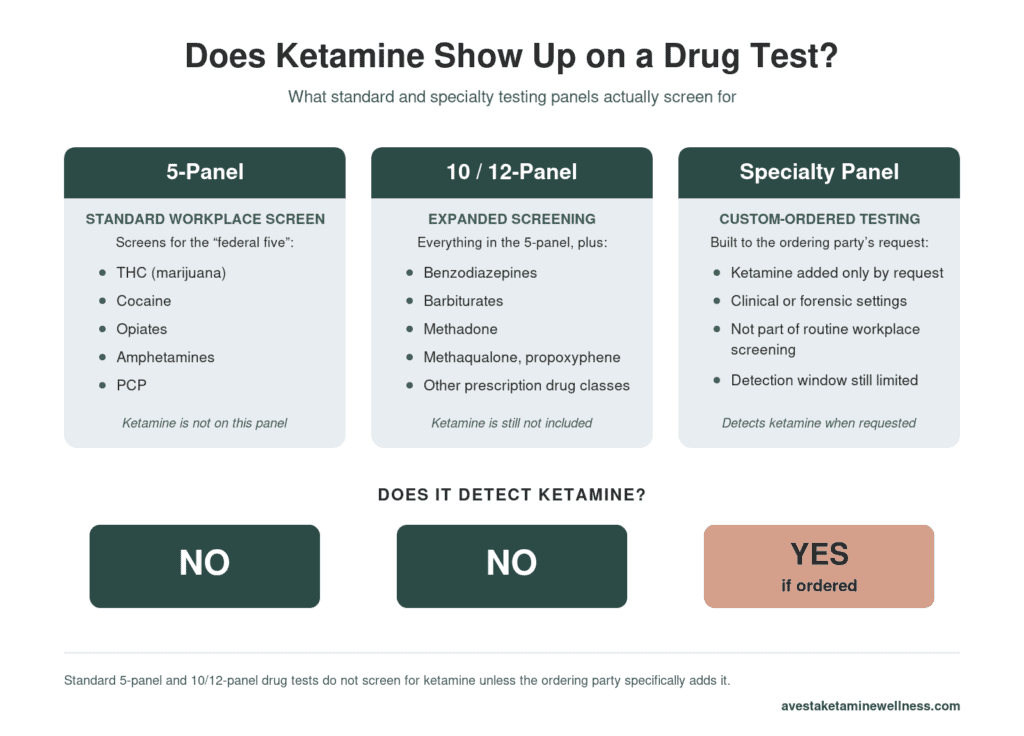
Ketamine and its byproducts, like norketamine and 5,6-dehydronorketamine (5,6-DHNK), do not appear on standard drug screens, which include 5-panel, 10-panel, and 12-panel tests. There are a few reasons for this:
- Ketamine is a legitimate FDA-approved medication for anesthesia and an evidence-based off-label treatment for depression and other conditions.[1]
- The body metabolizes ketamine quickly, so it is harder to catch on a standard test.[4]
- The specialized assays that screen for ketamine cost more, so labs do not add them by default.
Ketamine is a Schedule III controlled substance federally, scheduled in 1999.[3] That legal status matters at the disclosure stage, not the screening stage: being scheduled does not put ketamine on a routine panel.
The 5-Panel Test: Standard Workplace Screening
The 5-panel drug test is the most common form of private, public, and government-mandated workplace screening in the United States, including tests regulated by the Department of Transportation (DOT). It is designed to detect the most commonly misused illegal and high-risk substances, and ketamine is not one of them.
The standard 5-panel test, often called the “Federal Five” or SAMHSA-5, does not screen for ketamine.[2] It is limited to five drug classes:
1. Marijuana (THC): THC metabolites, the psychoactive component of cannabis.
2. Cocaine: the primary metabolite, benzoylecgonine.
3. Amphetamines/Methamphetamines: amphetamine, methamphetamine, and often ecstasy (MDMA).
4. Opioids/Opiates: natural opiates (codeine, morphine, heroin), semi-synthetic opioids (hydrocodone, oxycodone), and synthetic opioids. Fentanyl and norfentanyl were added to federal urine and oral-fluid testing programs effective July 7, 2025.[2] That change applies to federal-agency drug-free-workplace programs, not to DOT testing, which added fentanyl on its own separate schedule.
5. Phencyclidine (PCP): a dissociative hallucinogen, commonly known as “angel dust.”
If an employer wants a ketamine result, they have to request a customized screen. The Federal Five list does not get you there.
Does Ketamine Show Up on a 10- or 12-Panel Test?
No, ketamine is not part of an off-the-shelf 10-panel or 12-panel test either. When an employer or organization wants a broader screen than the 5-panel, they may order a 10-panel or 12-panel, which can appear in high-security roles, some healthcare and financial settings, and judicial or compliance programs such as probation.
These expanded panels keep the five core substances (THC, cocaine, amphetamines, opioids, PCP) and add five to seven more classes of commonly misused prescription and illicit drugs. A typical configuration includes:
| Category | Common examples screened for |
|---|---|
| The Federal Five | THC, cocaine, amphetamines, PCP, opioids (codeine, morphine, heroin) |
| Benzodiazepines | Xanax, Valium, Klonopin, Ativan |
| Barbiturates | phenobarbital, secobarbital |
| Methadone | medication for opioid addiction treatment |
| Propoxyphene | Darvon (largely discontinued) |
| Methaqualone | Quaaludes (largely historical) |
| Expanded opioids/oxycodones | oxycodone (OxyContin, Percocet), hydrocodone, Demerol, tramadol |
| MDMA/Ecstasy | added to the 12-panel in some configurations |
Ketamine is absent from every one of those categories. The only way it shows up on a test ordered as a “10-panel” or “12-panel” is if the ordering party customizes the request to add it, which is far more likely in the specialty settings below.
When Will Ketamine Be Detected? (Specialty Testing)

Ketamine is detected only when an organization or provider specifically orders a custom toxicology panel that includes ketamine as an analyte (often listed as KET). These panels are reserved for scenarios with a clear medical, legal, or safety-sensitive reason to monitor for ketamine use or misuse.
Pain Management and Substance-Use Programs
Clinics that prescribe controlled substances are the most common place for ketamine-specific testing. Many pain management and chronic care programs require regular urine drug testing (UDT) to confirm a patient is taking prescribed medication and avoiding non-prescribed or illicit substances. Ketamine may be added explicitly if the patient is receiving it as part of their regimen, or if the provider suspects the patient is off protocol. Individuals in addiction recovery programs are also tested intermittently and comprehensively, which can include ketamine.
Hospital and Emergency Toxicology
In emergencies, physicians may order a broad toxicology screen to diagnose an unclear presentation. Common triggers include altered mental status (confusion, dissociation, or hallucinations), suspected overdose, and severe medical complications such as respiratory distress or ketamine-related urinary symptoms.
Legal and Probation Evaluations
Forensic investigations, probation offices, and courts may use extended toxicology screens where ketamine is relevant to a case. Standard 5-panel or 10-panel tests are common for probation, but a judge or parole officer can order a customized screen that adds ketamine. Impaired-driving and criminal cases often use definitive methods (GC-MS or LC-MS/MS) that include ketamine. Child custody and family law disputes may call for long-window hair or fingernail testing when misuse is suspected.
Specialized Federal and State Safety Roles
Detection is more likely in fitness-for-duty and national-security positions, where testing often goes beyond DOT minimums. The Nuclear Regulatory Commission can order expanded testing for ketamine even when it is prescribed, if its presence is judged to conflict with safe performance of duties. DOD contractors and security-clearance environments may reserve the right to run expanded evaluations that include Schedule III drugs such as ketamine. State and local law enforcement and first responders are not bound by DOT rules and may use expanded screens at their discretion.[6]
How Long Does Ketamine Stay Detectable?

Ketamine’s detection window depends on the specimen type (urine, blood, saliva, hair), the dose, how often it was used, and the person’s metabolism. Depending on those factors, the compound can stay in your system for hours or, in some accounts, for weeks. The table below summarizes the windows.
| Specimen | Typical detection window | Source |
|---|---|---|
| Blood | Parent drug about 4 to 24 hours; the 5,6-DHNK metabolite up to 6 to 10 days | [5] |
| Saliva / oral fluid | Usually cleared within 4 to 6 hours; may persist 24 to 48 hours | [5] |
| Urine (single dose) | About 2 to 14 days | [5][8] |
| Urine (chronic/frequent use) | Reported as long as 22 to 96 days in a single study | [9] |
| Hair | Commonly cited up to roughly 90 days; one case report describes up to 4 months | [10] |
Urine (Most Common Test)
Urine is the most common specimen for drug screening because it is non-invasive and gives a moderately long window. Specialized lab toxicology can detect a single ketamine dose for about 2 to 14 days after administration.[5][8] Chronic or frequent use may extend that considerably; one study reported detection as long as 22 to 96 days, though that figure rests on a single source and should be read as an outer bound, not a norm.[9] Urine tests primarily detect norketamine, ketamine’s main inactive metabolite, along with minor metabolites such as dehydronorketamine and the hydroxyketamines.
Blood (Acute Detection)
Blood testing is invasive and expensive, so employers rarely use it. Acute medical and forensic settings (emergency rooms, accident investigations) are the usual place it appears. The parent drug is detectable for only a few hours, typically 4 to 8, and may remain up to about 24 hours, because the liver rapidly converts ketamine to norketamine.[5] An assay targeting ketamine’s longest-lasting metabolite, 5,6-DHNK, can extend plasma detection to roughly 6 to 10 days.[5]
Saliva / Oral Fluid (Short-Term)
Saliva testing is non-invasive and easy to administer, so roadside or immediate-suspicion settings may use it. Ketamine is mostly undetectable in saliva within 4 to 6 hours of use, though it can linger up to 24 to 48 hours.[5] Saliva detects the parent drug in the oral cavity and plasma, which points to very recent use.
Hair (Longest Window)
Hair follicle testing is the most expensive and least common workplace method, but it provides the longest historical window. A standard sample analyzes 90 to 120 strands cut from the scalp, representing roughly three months of use, and is generally cited as detecting ketamine up to about 90 days. One case report describes detection up to 4 months, which is best treated as a case-report maximum rather than a typical result.[10] Hair tests usually appear in legal, forensic, or sensitive security evaluations where establishing a history of use matters.
How Ketamine Therapy Patients Can Avoid Drug Testing Problems

If you are undergoing ketamine therapy (IV infusion, Spravato, or prescribed oral, sublingual, or spray forms) and have a drug screen coming up, a few proactive steps protect you.
Ask Which Substances the Test Includes
Ask your employer or the testing organization for documentation naming the panel being used (for example, “5-panel,” “10-panel,” or “expanded opioid panel”), and ask specifically whether ketamine is one of the analytes. For a standard employment test, the answer will almost certainly be no.
Notify the Tester or Medical Review Officer (MRO) Beforehand
Tell the collection-site administrator that you are taking a legally prescribed, Schedule III controlled substance. They do not need the drug name, only notice that the results may require review. The medical review officer, an independent physician who reviews results, will contact you confidentially if a test screens positive for ketamine.[6] That is your opportunity to provide documentation. The MRO reviews it and reports the result as “Negative” if they determine you are receiving ketamine for a legitimate medical reason.[7]
Consult Your Treating Clinic
Your ketamine provider is your best source of official documentation. Ask your clinician for a formal letter on clinic letterhead confirming your patient status, diagnosis, medication, and treatment date range. That letter is what turns a positive screen into a verified, legitimate result.
When to Contact Avesta
The Avesta Ketamine and Wellness team is here to help with any questions about ketamine therapy, including the administrative side such as drug-testing documentation and timing.
Reach out to our clinics in DC, Bethesda, Tysons, Norfolk, or Columbia if you have questions about:
- Requesting a formal treatment documentation letter to present to a medical review officer for an upcoming or recent drug test.
- Clarifying which specific drug panel your employer or ordering agency uses, and whether ketamine is included.
- Starting ketamine therapy and how we proactively manage the risk of complications with required drug screenings.
If you want the pharmacokinetics behind the timing, our guide on how long ketamine stays in your system covers it in detail.
Ready to talk it through? Book a consult with our care team and we will help you approach any drug screen with confidence.
FAQs About Drug Testing for Ketamine

Will ketamine appear on my employment drug test?
Highly unlikely. Standard workplace drug tests (5-panel, 10-panel, 12-panel, and DOT-mandated tests) do not automatically screen for ketamine.[2] Detection happens only if the employer or organization orders an expanded toxicology panel that specifically includes ketamine and its metabolites.
Does ketamine show up as an opioid or PCP on drug tests?
Highly unlikely. Specialized lab methods such as gas chromatography and mass spectrometry (GC-MS) accurately distinguish ketamine from opioids and PCP. An older or generic immunoassay could in theory produce a false positive, but a confirmatory GC-MS test clarifies the result.
Will I get fired if a drug test detects ketamine in my system?
Not typically, if you have a valid reason and follow protocol. Federal law, including the Americans with Disabilities Act, often protects employees who use legally prescribed medication for a legitimate condition. Termination risk rises in safety-sensitive roles (DOT, heavy machinery, aviation) or security-clearance jobs where any potentially impairing drug may violate regulations, and if you fail to disclose the prescription to the MRO. Evidence of impairment at work can also warrant termination. Employment law varies by state and industry, so consult your HR policy and an employment attorney.
Will I test positive for ketamine if I undergo Spravato therapy?
Yes, but only if the test screens for ketamine and its metabolites. Spravato (esketamine) is one of the two enantiomers that make up ketamine, so it is detectable on a ketamine panel. Proactive disclosure with clinical documentation helps patients avoid a problem.
How long does it take ketamine to leave my system?
It depends on the test type, dose, and frequency of use. Urine detects a single dose for about 2 to 14 days, and possibly far longer with chronic use.[5][8][9] Blood holds the parent drug for only hours (up to about 24), saliva is usually clear within 4 to 6 hours (up to 24 to 48), and hair can carry a record for weeks to months, with a rare case report reaching 4 months.[5][10]
References
- National Institute on Drug Abuse (NIDA). Ketamine. https://nida.nih.gov/research-topics/ketamine. Accessed July 22, 2026.
- Substance Abuse and Mental Health Services Administration (SAMHSA). Overview of Urine and Oral Fluid Drug Testing. https://www.samhsa.gov/sites/default/files/overview-urine-oral-fluid-drug-testing.pdf. Accessed July 22, 2026.
- U.S. Drug Enforcement Administration (DEA). Drug Scheduling. https://www.dea.gov/drug-information/drug-scheduling. Accessed July 22, 2026.
- Kamp J, et al. Pharmacokinetics of ketamine and its major metabolites. PMC9635017. https://pmc.ncbi.nlm.nih.gov/articles/PMC9635017/. Accessed July 22, 2026.
- Detection of ketamine and its metabolites across specimens (review). PMC6197107. https://pmc.ncbi.nlm.nih.gov/articles/PMC6197107/. Accessed July 22, 2026.
- Substance Abuse and Mental Health Services Administration (SAMHSA). Drug-Free Workplace Program and Medical Review Officer guidance. https://www.samhsa.gov/substance-use/drug-free-workplace. Accessed July 22, 2026.
- U.S. Department of Transportation, ODAPC. 49 CFR Part 40, Section 40.137 (Medical Review Officer duties). https://www.transportation.gov/odapc/part40/40-137. Accessed July 22, 2026.
- Journal of Analytical Toxicology. Urinary excretion of ketamine and norketamine following a single dose. https://academic.oup.com/jat/article-abstract/29/5/376/730685. Accessed July 22, 2026.
- Psychopharmacology. Prolonged ketamine and norketamine excretion in chronic users. https://journals.lww.com/psychopharmacology/abstract/2020/05000/prolonged_ketamine_and_norketamine_excretion.14.aspx. Accessed July 22, 2026.
- Drug Testing and Analysis. Detection of ketamine in hair (case report). https://analyticalsciencejournals.onlinelibrary.wiley.com/doi/10.1002/dta.3444. Accessed July 22, 2026.