
The main difference between ketamine and esketamine is composition. Ketamine is a racemic mixture, equal parts (50/50) of two mirror-image molecules. Esketamine, sold as Spravato®, is composed solely of the S-form and is the only one of the two FDA-approved for depression. That difference changes how each binds neural receptors, how it is given, and what the evidence supports.
As of July 2026, the comparative evidence still favors neither formulation decisively. The largest pooled analysis suggests racemic ketamine performs better, but it compares separate trials indirectly rather than head to head, and the first meta-analysis restricted to direct comparisons found no significant difference between them.[13][14] For the pharmacology of the two halves on their own, see our guide to s-ketamine vs r-ketamine.
What is the difference between esketamine and ketamine?
Ketamine is a 50/50 racemic mixture of two mirror-image molecules. Esketamine is one of those halves on its own, purified and delivered as a nasal spray. Esketamine is FDA-approved for treatment-resistant depression. Racemic ketamine is approved only as an anesthetic and is used off-label for depression.[6][16]
Mirror-image molecules are called enantiomers. They share a chemical formula and differ in shape, and shape is what decides how tightly a molecule fits the receptors it acts on. Esketamine is not a ketamine analog, a separate compound built to imitate ketamine. It is a component of ketamine, sold on its own.
The practical differences follow from that. The two are given by different routes, on different schedules, under different regulatory rules, and the research base behind each looks different as a result. The table below sets them side by side.
Esketamine vs racemic ketamine compared: composition, FDA status, route, protocol, and evidence
| Feature | Racemic ketamine | Esketamine (Spravato) |
|---|---|---|
| Composition | A 50/50 mixture of both mirror-image forms of the ketamine molecule.[6] | The S-form alone, purified from that mixture.[6] |
| FDA status | Approved as an anesthetic only. Not approved for any psychiatric condition, and prescribed off-label for depression.[16] | Approved for treatment-resistant depression as monotherapy or with an oral antidepressant, and for depressive symptoms in adults with major depressive disorder with acute suicidal ideation or behavior, given with an oral antidepressant.[7] |
| Administration route | Intravenous infusion in clinic. Intramuscular injection is also used.[3] | Intranasal spray, self-administered under a provider’s supervision in a certified treatment center.[7] |
| Typical protocol | A subanesthetic dose over roughly a 40-minute infusion, commonly six sessions across about three weeks. No FDA-approved psychiatric dosing regimen exists.[3][16] | 56 mg or 84 mg twice weekly for weeks 1 to 4, weekly for weeks 5 to 8, then weekly or every two weeks. At least two hours of observation after every dose.[7] |
| Evidence base | Placebo-controlled trials since 2000, pooled in a meta-analysis showing improvement within four hours, peaking at 24 hours, and still present though reduced at seven days.[3][5] | Phase 3 program supporting approval, including TRANSFORM-2 for acute efficacy and SUSTAIN-1 for relapse prevention.[9][10] |
| Direct comparison (2025) | In eight studies comparing the two directly (978 patients), no significant difference in response (odds ratio 1.26) or remission (odds ratio 1.31). IV may act faster.[14] | Same pooled result. The underlying evidence is almost entirely observational rather than randomized.[14] |
What is racemic ketamine?
Ketamine, also called racemic ketamine, is a dissociative anesthetic mixture that is typically administered as a clear liquid solution for intravenous (IV) administration.
Discovery and development
Ketamine was synthesized in 1962 by Calvin Stevens, an organic chemist consulting for Parke-Davis, and first given to a human as a surgical anesthetic in 1964, valued for its rapid onset and short duration of action.[1] Its pharmacological properties quickly drew attention outside anesthesia. Its ability to modulate glutamate neurotransmission and promote neuroplasticity pointed toward uses in depression, PTSD, severe anxiety, OCD, suicidality, and substance use conditions.

Pharmacological mechanisms
Ketamine’s effect in depression is attributed to its action on the glutamatergic system through NMDA receptors.[2] By blocking these receptors, ketamine stops the binding of glutamate, the brain’s primary excitatory neurotransmitter.
This blockade triggers downstream effects, including increased release of brain-derived neurotrophic factor (BDNF) and activation of AMPA receptors.[2] These mechanisms strengthen and build new neural connections, supporting the brain’s ability to adapt and change.
IV ketamine protocol
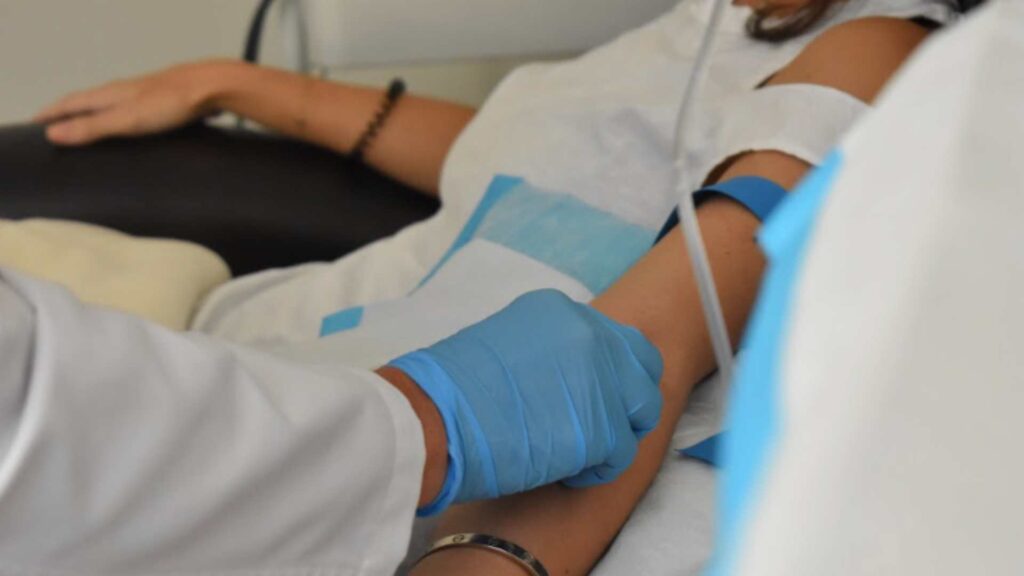
A typical IV ketamine therapy protocol for depression involves administering a subanesthetic dose of racemic ketamine over a 40-minute infusion period. Treatment often consists of six sessions, typically over three weeks. There is no FDA-approved dosing regimen for any psychiatric indication, so protocols follow published consensus rather than a label.[16]
- Acute effects during and immediately after ketamine infusions include dissociation, perception changes (detachment and hallucinations), and mild sedation. Other temporary side effects, all monitored in real time during treatment, include nausea and dizziness.
- A meta-analysis of IV ketamine trials for treatment-resistant depression found a strong effect within four hours, peaking at 24 hours, and still present though diminished seven days after infusion.[3]
- Repeated IV infusions may also ease PTSD symptoms. In a small open-label study of 15 veterans with both PTSD and treatment-resistant depression, those whose PTSD went into remission after a six-infusion series stayed in remission for a median of 41 days.[4] Patients who engage in talk therapy alongside infusions may remain in remission longer.
IV ketamine containing a racemic mixture is the most common form of ketamine used for mental health conditions. The first placebo-controlled, double-blind trial of an NMDA-receptor antagonist in patients with depression was published in 2000, and the evidence base has grown steadily since.[5]
What is esketamine (Spravato)?
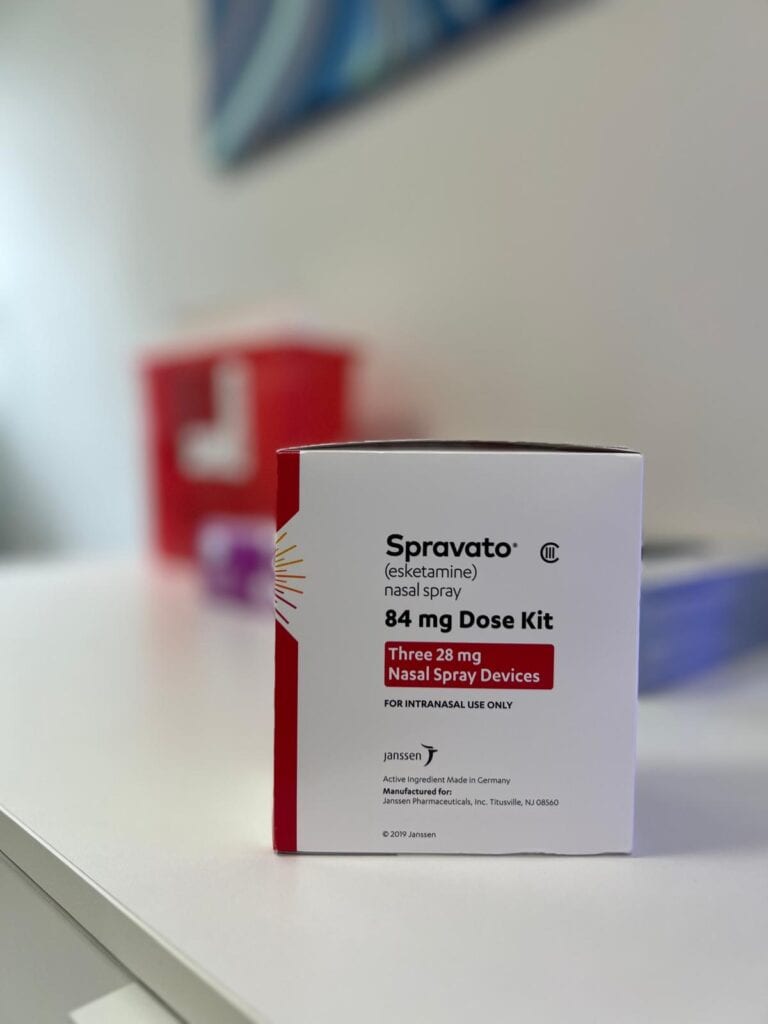
Esketamine, also known as S(+)-ketamine, is a dissociative anesthetic. However, it specifically includes only the S(+)-enantiomer of the racemic ketamine mixture and typically comes in a nasal spray formulation.
Discovery and development
Researchers developed esketamine as a pharmaceutical product with the hope of improving on racemic ketamine’s pharmacological properties with fewer side effects. Scientists found that ketamine’s S-enantiomer exhibited more potent NMDA receptor antagonism and appeared responsible for many of ketamine’s desirable effects, such as its rapid antidepressant action.[6]
In 2019, the U.S. Food and Drug Administration (FDA) approved esketamine for treatment-resistant depression. Janssen Pharmaceuticals markets the compound under the brand name Spravato®.
Pharmacological mechanisms
Both esketamine and racemic ketamine are antagonists at NMDA receptors, which are involved in glutamatergic neurotransmission. Pre-clinical research shows that esketamine has roughly four times the NMDA-receptor affinity of the other enantiomer in the racemic mixture, measured in vitro.[6] Some experts believe this more potent and selective binding results in more targeted antidepressant effects.
Esketamine protocol
Spravato (esketamine) nasal spray is self-administered under a licensed provider’s supervision in a certified treatment center. Under the current prescribing information, revised in 2025, it is indicated for treatment-resistant depression in adults as monotherapy or in conjunction with an oral antidepressant, and for depressive symptoms in adults with major depressive disorder with acute suicidal ideation or behavior in conjunction with an oral antidepressant. The label also states that effectiveness in preventing suicide or reducing suicidal ideation or behavior has not been demonstrated.[7]
Dosing is 56 mg or 84 mg, given twice a week during weeks 1 through 4, once a week during weeks 5 through 8, and then weekly or every two weeks from week 9 onward, individualized to the least frequent dosing that maintains response. Every session requires at least two hours of observation before a patient can leave, and patients are told not to drive until the next day after a restful sleep.[7] The 2019 label specified a fixed 56 mg first dose. The current one does not, which is one reason to read the current version rather than a summary of the original approval.
- Acute esketamine effects during and immediately after dosing can mimic racemic ketamine, including dissociation, nausea, and dizziness. An early two-patient case report described dissociative effects that were present on racemic ketamine and absent on S-ketamine, though later controlled work has not borne this out as a general advantage.[8]
- In the TRANSFORM-2 phase 3 trial, esketamine added to a newly initiated oral antidepressant produced greater symptom improvement than placebo at the day-28 primary endpoint, with clinically meaningful separation appearing at earlier assessments, the first of which was 24 hours.[9]
- A phase 3 withdrawal study showed that esketamine plus an oral antidepressant can reduce relapse. Among patients who achieved stable remission, 26.7 percent of those who continued esketamine relapsed, compared with 45.3 percent of those switched to a placebo nasal spray alongside their oral antidepressant, a 51 percent lower relapse risk (hazard ratio 0.49).[10]
Clinicians have been prescribing esketamine since it received FDA approval in 2019. Spravato is covered by many commercial and government plans, though coverage, prior-authorization requirements, and out-of-pocket cost vary by plan. Our insurance coverage for ketamine and Spravato page explains how we verify benefits.
Esketamine vs. Ketamine for Depression: What Do The Studies Say?
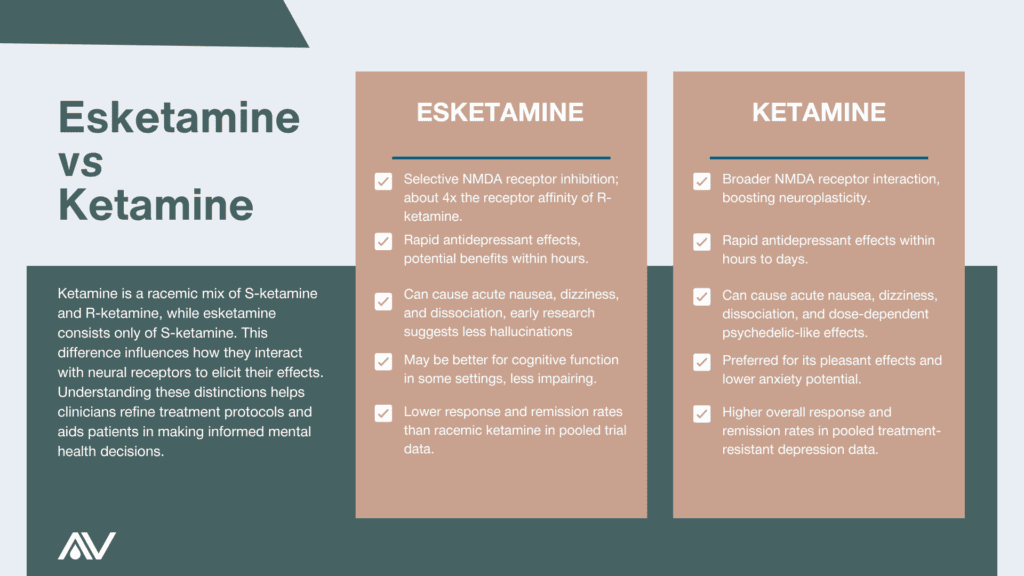
Early research suggested that esketamine may be more effective and better tolerated for treating depression, on the strength of its affinity for glutamate NMDA receptors, its rapid effects, and a reduced hallucinogenic profile. The later comparative analyses point the other way, and the most recent evidence points at neither.
Is esketamine less impairing than racemic ketamine?
In one early study it was, on a narrow set of measures and at a very early timepoint. A 2002 crossover trial in 24 healthy volunteers compared equianalgesic intravenous doses of racemic ketamine, esketamine, and the R-form on hemodynamic and cognitive measures for 60 minutes following administration.[11]
Researchers found that:
- Subjects experienced similar transient increases in blood pressure, heart rate, and circulating catecholamines across all three administrations.[11]
- Overall, the single-enantiomer preparations, especially esketamine, caused less drowsiness, tiredness, and cognitive impairment over the 60 minutes than equianalgesic racemic ketamine.
- Esketamine specifically caused less decline in concentration capacity and primary memory, measured one minute after injection.
This suggested esketamine might suit patients concerned about cognitive function immediately after treatment. Later comparative clinical trials did not reproduce the distinction, and the study’s own authors noted the differences could not be explained by selective action at any single receptor.
Does racemic ketamine offer a better composition for treating depression?
One 2021 study argues it might, though it studied healthy volunteers rather than patients. That randomized, double-blind, placebo-controlled trial gave three groups of 10 healthy male volunteers subanesthetic doses of racemic ketamine, esketamine, or placebo by continuous IV infusion.[12]
Key findings of the study included:
- Both racemic ketamine and esketamine significantly affected psychopathology and neurocognitive performance compared with placebo, with no significant differences between the two.[12]
- Esketamine was associated with somewhat more negatively experienced psychopathology.
The authors concluded that the ideal ketamine composition for treating depression should include the R-form, the half that esketamine leaves out, citing the more pleasant altered-consciousness experience and lower anxiety potential. Because no depressed patients took part, the study speaks to the subjective experience of each formulation rather than to how well either treats depression.
Does racemic ketamine perform better than esketamine for treatment-resistant depression?
In the largest pooled analysis, yes, but the comparison is indirect. A systematic review and meta-analysis in 2021 compared racemic ketamine and esketamine for unipolar and bipolar major depression, pooling 24 randomized controlled trials representing 1,877 participants and looking at response, remission, symptom severity, suicidality, and retention in treatment.[13]
- Racemic ketamine showed a higher overall response (RR = 3.01) and remission rate (RR = 3.70) than esketamine (RR = 1.38 for response, RR = 1.47 for remission).[13]
- Racemic ketamine also showed lower dropout rates (RR = 0.76) versus esketamine (RR = 1.37).
The caveat matters as much as the numbers. These are not head-to-head comparisons. The analysis pooled separate placebo-controlled trials of each formulation and compared them indirectly, and the authors state that direct head-to-head trials are needed to confirm the finding. Several published commentaries have pressed that same point. The results suggest intravenous racemic ketamine may be more effective than intranasal esketamine for depression, but the question remains genuinely open.
What happens when the two are compared head to head?
The gap closes. A 2025 meta-analysis restricted to studies that compared the two directly pooled eight comparisons covering 978 patients and found no significant difference in response (odds ratio 1.26, 95% confidence interval 0.92 to 1.71) or in remission (odds ratio 1.31, 95% confidence interval 0.93 to 1.86). IV ketamine may act faster.[14]
That result carries its own limit, and the authors say so plainly: the evidence pooled is almost entirely observational rather than randomized, so it describes what happened in clinics rather than settling which treatment is better. A separate 2023 analysis of 49 randomized trials in 3,299 participants found effect sizes numerically greater for racemic ketamine, with racemic effects still measurable at follow-up where esketamine’s were not.[15]
Bottom line: indirect pooling favors racemic ketamine, direct comparison finds a draw, and neither body of evidence is strong enough to tell an individual patient which formulation will work better for them.
Esketamine vs. Ketamine at Avesta

Our clinicians in Bethesda and Columbia, Maryland; Washington, DC; and Tysons (Vienna) and Norfolk, Virginia, offer both IV ketamine and esketamine nasal spray treatments based on our patients’ specific needs and situations.
We emphasize IV ketamine’s long history in treating conditions like depression, PTSD, and anxiety with lasting effects for responders. We also recognize Spravato’s rapid antidepressant action, its insurance coverage, its administration method, and the fact that it is FDA-approved for treatment-resistant depression.
We educate patients about both options, including the financial implications and what the efficacy evidence does and does not show, so that they can make informed decisions about their treatment.
The Bottom Line: We Need More Research
Indirect pooled analyses suggest racemic ketamine may have higher efficacy and better tolerability than esketamine for treatment-resistant depression. The first meta-analysis of direct comparisons, published in 2025, found no significant difference between them, on evidence that was almost entirely observational. Both readings point at the same missing piece: randomized, double-masked trials comparing the two formulations directly.
Those trials would help determine the optimal ketamine formulation and administration strategy, and could lead to better protocols for depression and other psychiatric conditions. Until they exist, the honest answer is that the choice between the two rests on route, diagnosis, coverage, and individual response rather than on a settled efficacy winner.
Frequently asked questions
Is esketamine the same thing as ketamine?
Not quite. Ketamine is a racemic mixture of two mirror-image molecules in a 50/50 ratio. Esketamine is one of those two halves on its own, the S-enantiomer. It is not a different medicine or a ketamine analog. It is a single component of ketamine, purified and delivered as a nasal spray.
What does racemic mean in racemic ketamine?
Racemic means the medicine contains equal amounts of both mirror-image forms of the same molecule. Ketamine as manufactured for anesthesia and used for depression is racemic: a 50/50 blend. Esketamine is what you get when one of those two halves is separated out and sold on its own.
Is esketamine stronger than racemic ketamine?
It binds more tightly, but that does not translate directly into a stronger clinical effect. Pre-clinical work shows esketamine has roughly four times the NMDA-receptor affinity of the other enantiomer. Dosing accounts for that difference, and the two formulations are given by different routes, so binding affinity alone does not tell you which will work better for a given patient.
Is esketamine FDA-approved when racemic ketamine is not?
Yes, for depression. Esketamine is approved as Spravato for treatment-resistant depression, and for depressive symptoms in adults with major depressive disorder with acute suicidal ideation or behavior. Racemic ketamine is FDA-approved as an anesthetic and is not approved for any psychiatric condition, so its use for depression is off-label.
Which works better for treatment-resistant depression?
No formulation has been shown to be better. The largest pooled analysis, covering 24 trials and 1,877 participants, found higher response and remission rates for racemic ketamine, but it compared separate trials indirectly. A 2025 meta-analysis of studies comparing the two directly found no significant difference. Our clinicians weigh both alongside route of administration, coverage, and individual history.
Is Spravato covered by insurance when IV ketamine is not?
Often, yes. Spravato is FDA-approved for treatment-resistant depression, so many commercial and government plans cover it, usually with prior authorization. IV ketamine for mental health is prescribed off-label and is less consistently covered. Coverage, authorization requirements, and out-of-pocket cost vary by plan, so we verify benefits before treatment begins.
References
- Li L, Vlisides PE. “Ketamine: 50 Years of Modulating the Mind.” Frontiers in Human Neuroscience, 2016;10:612. PMID 27965560, PMC5126726. pmc.ncbi.nlm.nih.gov. Accessed July 30, 2026.
- Zorumski CF, Izumi Y, Mennerick S. “Ketamine: NMDA Receptors and Beyond.” Journal of Neuroscience, 2016;36(44):11158-11164. PMID 27807158, PMC5148235. pmc.ncbi.nlm.nih.gov. Accessed July 30, 2026.
- Marcantoni WS, Akoumba BS, Wassef M, et al. “A systematic review and meta-analysis of the efficacy of intravenous ketamine infusion for treatment resistant depression: January 2009 – January 2019.” Journal of Affective Disorders, 2020;277:831-841. PMID 33065824. pubmed.ncbi.nlm.nih.gov. Accessed July 30, 2026.
- Albott CS, Lim KO, Forbes MK, et al. “Efficacy, Safety, and Durability of Repeated Ketamine Infusions for Comorbid Posttraumatic Stress Disorder and Treatment-Resistant Depression.” Journal of Clinical Psychiatry, 2018;79(3):17m11634. PMID 29727073. pubmed.ncbi.nlm.nih.gov. Accessed July 30, 2026.
- Berman RM, Cappiello A, Anand A, et al. “Antidepressant effects of ketamine in depressed patients.” Biological Psychiatry, 2000;47(4):351-354. PMID 10686270. pubmed.ncbi.nlm.nih.gov. Accessed July 30, 2026.
- Molero P, Ramos-Quiroga JA, Martin-Santos R, et al. “Antidepressant Efficacy and Tolerability of Ketamine and Esketamine: A Critical Review.” CNS Drugs, 2018;32(5):411-420. PMID 29736744. pubmed.ncbi.nlm.nih.gov. Accessed July 30, 2026.
- U.S. Food and Drug Administration. “SPRAVATO (esketamine) nasal spray, CIII: Highlights of Prescribing Information.” Revised 2025. accessdata.fda.gov. Accessed July 30, 2026.
- Paul R, Schaaff N, Padberg F, Moller HJ, Frodl T. “Comparison of racemic ketamine and S-ketamine in treatment-resistant major depression: report of two cases.” World Journal of Biological Psychiatry, 2009;10(3):241-244. PMID 19224412. pubmed.ncbi.nlm.nih.gov. Accessed July 30, 2026.
- Popova V, Daly EJ, Trivedi M, et al. “Efficacy and Safety of Flexibly Dosed Esketamine Nasal Spray Combined With a Newly Initiated Oral Antidepressant in Treatment-Resistant Depression (TRANSFORM-2).” American Journal of Psychiatry, 2019;176(6):428-438. PMID 31109201. Erratum in Am J Psychiatry 2019;176(8):669. pubmed.ncbi.nlm.nih.gov. Accessed July 30, 2026.
- Daly EJ, Trivedi MH, Janik A, et al. “Efficacy of Esketamine Nasal Spray Plus Oral Antidepressant Treatment for Relapse Prevention in Patients With Treatment-Resistant Depression: A Randomized Clinical Trial (SUSTAIN-1).” JAMA Psychiatry, 2019;76(9):893-903. PMID 31166571, PMC6551577. pmc.ncbi.nlm.nih.gov. Accessed July 30, 2026.
- Pfenninger EG, Durieux ME, Himmelseher S. “Cognitive impairment after small-dose ketamine isomers in comparison to equianalgesic racemic ketamine in human volunteers.” Anesthesiology, 2002;96(2):357-366. PMID 11818769. pubmed.ncbi.nlm.nih.gov. Accessed July 30, 2026.
- Passie T, Adams HA, Logemann F, Brandt SD, Wiese B, Karst M. “Comparative effects of (S)-ketamine and racemic (R/S)-ketamine on psychopathology, state of consciousness and neurocognitive performance in healthy volunteers.” European Neuropsychopharmacology, 2021;44:92-104. PMID 33487513. pubmed.ncbi.nlm.nih.gov. Accessed July 30, 2026.
- Bahji A, Vazquez GH, Zarate CA Jr. “Comparative efficacy of racemic ketamine and esketamine for depression: A systematic review and meta-analysis.” Journal of Affective Disorders, 2021;278:542-555. PMID 33022440. Erratum in J Affect Disord 2021;281:1001. pubmed.ncbi.nlm.nih.gov. Accessed July 30, 2026.
- Elmosalamy A, Tarikogullari I, Patarroyo-Rodriguez L, et al. “Intravenous ketamine versus esketamine for depression: a systematic review and meta-analysis.” Therapeutic Advances in Psychopharmacology, 2025;15:20451253251394127. PMID 41244961, PMC12615959. pmc.ncbi.nlm.nih.gov. Accessed July 30, 2026.
- Nikolin S, Rodgers A, Schwaab A, et al. “Ketamine for the treatment of major depression: a systematic review and meta-analysis.” eClinicalMedicine, 2023;62:102127. PMID 37593223, PMC10430179. pmc.ncbi.nlm.nih.gov. Accessed July 30, 2026.
- U.S. Food and Drug Administration. “Understanding the Current Use of Ketamine and Emerging Areas of Therapeutic Interest.” June 27, 2024. fda.gov. Accessed July 30, 2026.


