Written by Deborah Tan. Medically reviewed by Dr. Ladan Eshkevari, CRNA, PhD, FAAN.

Ketamine therapy in Washington, DC costs about $300 to $2,000 per IV session without insurance as of July 2026. With coverage, patients at our Washington, DC ketamine clinic can pay as little as $0 to $150 per visit in co-pays, and Spravato medication can drop to $0 with insurer approval.
Key takeaways
- IV ketamine in DC runs roughly $300 to $2,000 per session without insurance: the American Society of Ketamine Physicians, Psychotherapists and Practitioners considers $400 to $800 per treatment reasonable.[1]
- Spravato medication can cost as little as $0 to $10 per treatment with insurer approval: most major DC insurers cover it because the FDA approved it for treatment-resistant depression in 2019.[2][3]
- We are in-network for IV ketamine with Cigna and the VA and bill United Healthcare, UMR, Kaiser, and Aetna on your behalf, which is how co-pays as low as $0 to $150 per visit become possible.
- No coverage is not a dead end: DC Medicaid, VA referrals, Ten Ten Life scholarships, HSA/FSA funds, financing, and employer benefits through Enthea and Tara Mind all reduce out-of-pocket costs.
Ketamine therapy is a clinically effective treatment for conditions like depression, PTSD, and chronic pain. However, high costs in places like Washington, D.C., can create a significant roadblock for patients, especially since insurance plans don’t cover IV infusions and ketamine clinics are often out-of-network with providers.
Fortunately, some DC insurance providers offer partial coverage for ketamine therapy and complete coverage for Spravato. Additionally, some clinics, like ours, are in-network with commercial insurers. Such clinics charge patients as little as $0 to $150 in co-pays per IV session. Medical assistance programs, veterans benefits, and private financing options can also offset DC ketamine costs.
Ketamine Therapy Costs in DC: How Does It Work?
Ketamine therapy costs nationally vary based on the therapy method (e.g., Spravato nasal spray vs. IV infusion), amenities, and service offerings. The same is true at DC clinics like ours.
Treatment type is by far the most significant factor affecting ketamine therapy costs in DC and throughout the country.
- IV Infusions: Ketamine infusions administered in-clinic via IV into the veins are the most effective treatment method in DC and nationwide. However, infusions are expensive, ranging from $300 to $2,000 per dose over a six-session protocol.[1]
- Ketamine-Assisted Psychotherapy (KAP): KAP combines ketamine dosing with psychotherapy sessions before, during, and after the protocol. It costs more than ketamine alone because therapist fees are added to administration and monitoring costs. Individual psychotherapy commonly runs $100 to $250 per session in the US, and more in large metros like DC, so each KAP session can range between $600 and $1,200.[7]
- Intramuscular (IM) Injections: IM ketamine is an injection alternative to IV offered at some DC clinics. At our DC clinic, IM ketamine is $450 per session cash, or $425 per session in a 6-session package, the same as our self-pay IV rate. IM does not offer the precise dosing control of IV, which may matter for patients who are apprehensive about the medicine’s dissociative effects.
- Spravato: Most DC insurers cover Spravato, an esketamine nasal spray (esketamine is the S-enantiomer of ketamine), due to its FDA approval status.[2] Eligible patients may pay as little as $0 in co-pays or $10 per treatment via a savings program.[3]
- Oral Tablets: Oral ketamine tablets, taken under the tongue, range from $75 to $200 per prescription. However, at-home prescriptions are not the safest or most effective method for treating severe mental illness.
- Ketamine Nasal Sprays: Generic intranasal ketamine sprays vary from $50 to $300 per bottle, with the same at-home drawbacks as oral tablet prescriptions. Risks include overuse, dependence, heart issues, and psychological harm.
What Else Drives Ketamine Pricing in DC?
Treatment type sets the baseline, but three other factors move the final bill.
01. Additional costs and fees
- Consultation fees: DC clinics may charge for initial and follow-up assessments. These fees cover clinicians’ time and are often separate from treatment sessions.
- Pre-treatment lab work: blood tests and urine screenings may be necessary to assess baseline health markers and screen for conditions that could affect treatment. Ask whether these are covered by insurance.
- Monitoring fees: nearly all ketamine therapy types require clinician monitoring for patient safety. These fees vary with duration and treatment type.
- Ancillary services: some clinics offer nutritional counseling, mindfulness training, or integrative therapies that can improve the experience but add cost.
- Indirect expenses: transportation and time off work for appointments add up across a six-session protocol and belong in the overall budget.
02. Provider expertise
Clinics with extensive medication administration and management experience often charge higher fees. Advanced training, certifications, and experience support more personalized treatment plans, thorough monitoring, and effective follow-up care, all of which contribute to cost.
03. Facility quality
High-end clinics with private treatment rooms, newer equipment, extended monitoring, or supplementary services (yoga, meditation, nutritional counseling) price those amenities into each session.
Why Do Most DC Insurers Not Cover Ketamine?
Insurance providers in DC and throughout most of the country do not cover IV ketamine therapy. Despite years of clinical data, the compound is not FDA-approved for mental health, so clinicians must administer it “off-label.” As a result, most ketamine clinics do not have in-network partnerships with insurers.
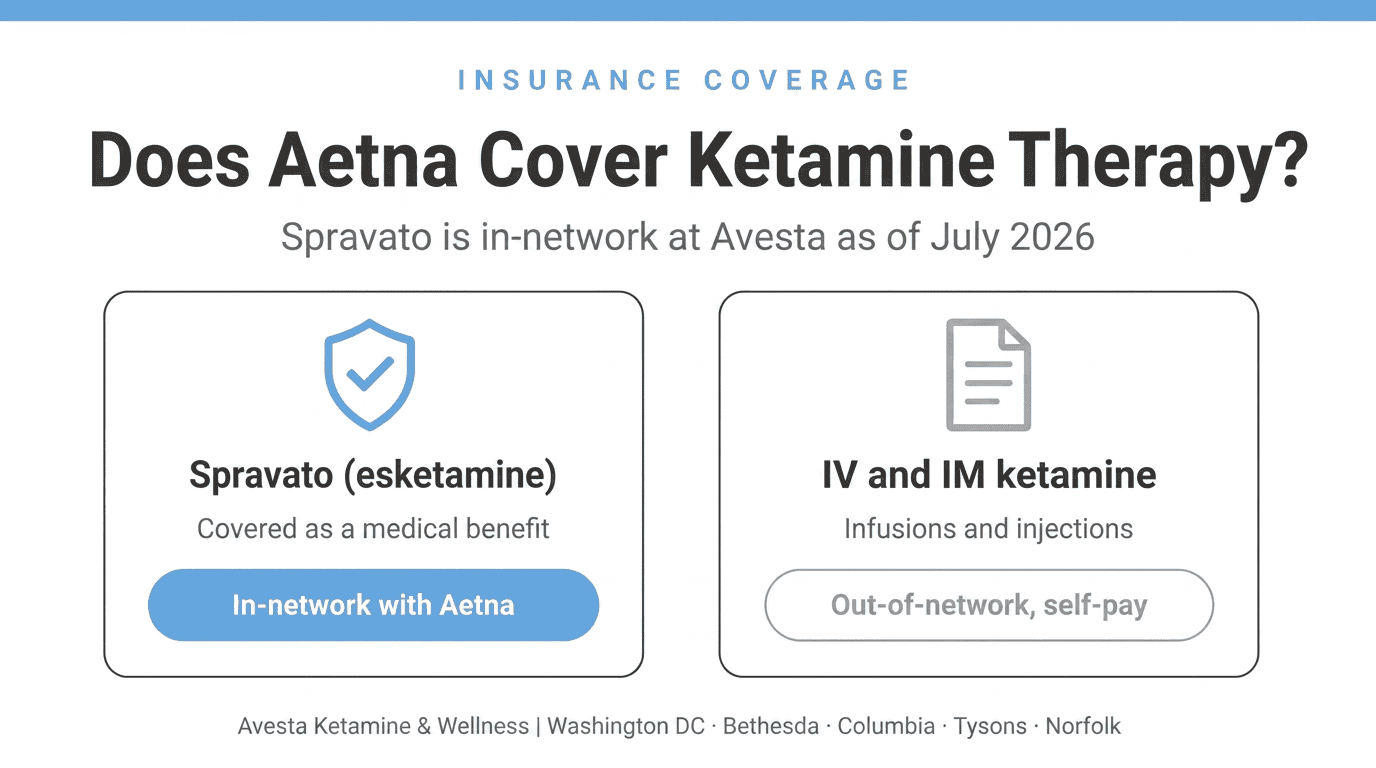
Our DC ketamine clinic is a rare exception. We provide in-network coverage for Cigna patients and simple out-of-network billing for United Healthcare, UMR, Kaiser, and Aetna.
01. Examining ketamine’s off-label status
Decades of clinical research show ketamine can deliver rapid mood-elevating effects for many people with treatment-resistant depression and suicidality.[5] In veterans with treatment-resistant depression and co-occurring PTSD, repeated ketamine-based treatment has been associated with improvement in both conditions.[6]
Still, the FDA has not approved generic ketamine infusions, tablets, or nasal sprays as a mental health treatment. Lack of approval means Medicare, Medicaid, and private insurers do not have to include IV ketamine in their drug catalogs or coverage plans.
Spravato (esketamine) is the exception. In 2019, the FDA approved Spravato for treatment-resistant depression and major depressive disorder with acute suicidal ideation.[2] Spravato is the S-enantiomer of ketamine, which means it contains only one of the two mirror-image forms of the ketamine molecule.
Read our article on the differences between IV ketamine and Spravato for depression.
02. Ketamine clinics’ “out of network” issue
Another obstacle to DC ketamine therapy coverage is finding an “in-network” clinic. Ketamine clinics in DC are generally “out of network,” meaning they do not have direct relationships with insurance companies to offer services at negotiated rates.
Out-of-network benefits typically include higher deductibles, copayments, and more out-of-pocket costs, if the insurer provides any benefits at all. HMO providers, for example, usually limit coverage to doctors who work for or contract with them, so HMOs rarely cover out-of-network ketamine care.
Ketamine Insurance Coverage Options in DC

Financial barriers are steep, but complete or partial ketamine coverage in DC is possible through insured Spravato treatments, reimbursements for IV treatment, pre-authorized use, and financial assistance options.
01. Full Spravato coverage for eligible patients
To qualify for full Spravato coverage, patients must receive an FDA-approved diagnosis of treatment-resistant depression or major depressive disorder.[4] Additionally, they must obtain prior authorization from their provider, which can present challenges and delays.
DC providers that cover Spravato therapy include all major providers, such as:
Price: Eligible patients pay as little as $0 or a standard co-pay per Spravato session.[3]
02. IV ketamine coverage
Insurance companies do not cover IV ketamine infusion medications. However, some aspects of the treatment process are covered, such as office visits, IV ketamine procedures, integration therapy, medication management, and follow-up appointments, depending on the plan.
Price: DC IV ketamine therapy can cost as little as $0 to $150 per visit in co-pay fees for patients who have met the insurance plan deductible. These patients must receive treatment at a ketamine clinic that bills the provider directly for services.
We bill every major provider except Blue Cross Blue Shield to determine the best price for patients. See our insurance page for the full payer list, or call us to determine costs and coverage.
03. Partial reimbursement
Patients receiving IV ketamine infusions at clinics that do not accept insurance (either in-or-out-of-network) can request reimbursement for ancillary costs, such as:
- The office visit
- The “evaluation and management” part of the infusion appointment
- Medical monitoring
- Additional medications
How to request reimbursement: DC patients must provide insurers with superbill codes to request reimbursement for ketamine therapy. Superbill codes, or service codes, are detailed invoices that healthcare providers use to describe the treatments given to a patient.
Submitting superbills sometimes involves the ketamine clinic preparing the superbill after a patient’s visit. Patients can then submit this superbill to their insurance company to reimburse non-medication-related out-of-pocket expenses.
Our DC clinic offers Blue Cross Blue Shield patients free access to reimbursement software, Reimbursify, to streamline the superbill process.
04. Prior authorization
DC residents who prefer IV ketamine therapy over Spravato will have a harder time gaining coverage. However, patients can ask their healthcare provider to “pre-authorize” or advocate for the necessity of ketamine treatment and plead the case to the insurance company.
This process requires the patient’s primary care doctor or therapist to submit a request to the insurance company, arguing the medical necessity of IV ketamine treatment. Upon reviewing these requests, insurance companies may approve and agree to fund the treatment ahead of time despite its non-standard status.
DC Ketamine Financial Assistance and Support Options

If insurance coverage is not an option, DC patients may be able to obtain affordable ketamine therapy through private and public financial assistance programs. For the full playbook on lowering out-of-pocket costs, see our guide on how to pay for ketamine therapy.
01. Medicaid and medical assistance programs
DC residents without private insurance benefits can seek financial aid through medical assistance programs like the Health Care Alliance and DC Medicaid. These programs provide eligible residents with health coverage and financial assistance based on income, age, or disability status.
02. Veterans Affairs (VA) coverage
Some DC ketamine clinics, including ours, are VA-approved providers of ketamine therapy, offering in-network care through the VA (Veterans Affairs). These partnerships allow eligible veterans to access IV ketamine or Spravato treatments at no cost with an authorized referral. Veterans with VA coverage should contact their healthcare provider to discuss eligibility and request a referral to a participating clinic.
03. Ten Ten Life for service members, military, first responders, and veterans
DC residents may be able to access free or discounted ketamine through a scholarship from Ten Ten Life. Ten Ten Life provides financial support for eligible service members, veterans, first responders, and their families to receive trauma-informed ketamine therapy. Applicants can apply directly to Ten Ten Life to determine eligibility and connect with participating ketamine clinics in the area.
04. Employer benefits
Although not yet the norm, some businesses offer ketamine therapy benefits through their healthcare plans. Dr. Bronner’s was among the first national employers to provide ketamine-assisted therapy benefits through the mental health benefits company Enthea.[8] Our Washington DC clinic partners with Enthea and Tara Mind to provide subsidized ketamine therapy to local patients. Ask your HR team whether your plan includes either program.
05. HSA/FSA accounts
Health Savings Accounts (HSAs) and Flexible Spending Accounts (FSAs) allow patients to set aside pre-tax dollars for qualified medical expenses, such as ketamine therapy. To open these accounts, patients in DC must be enrolled in a high-deductible health plan (HDHP) and provide documentation verifying ketamine as an eligible expense.
06. Private financing options
Ketamine clinics typically offer private financing options through healthcare credit cards. These payment methods help DC patients avoid the stress of upfront costs and pay the expenses in affordable increments.
- Advance Care: our DC clinic has a strategic partnership with Advance Care, which offers flexible plans with manageable monthly payments and interest-free financing.
- CareCredit: we also partner with CareCredit, another reputable financing company that offers a range of short-term plans with low-interest and interest-free options and fixed monthly payments.
Patients can also look for local ketamine clinical trials and enroll in treatment at reduced or no cost.

FAQs
What is ketamine infusion therapy used for?
People seek ketamine infusion therapy for conditions like treatment-resistant depression, anxiety, PTSD, and chronic pain. Our DC ketamine clinic also treats patients with bipolar disorder, obsessive-compulsive disorder (OCD), substance use disorder (SUD), and migraines.
What insurance covers ketamine therapy?
Insurance typically does not cover generic ketamine infusions because they are not FDA-approved for mental health. However, most commercial plans cover parts of the treatment, like office visits, and fully cover Spravato (esketamine) nasal spray.
Which insurance plans does Avesta’s DC ketamine clinic accept?
We partner with all major insurance providers to provide patients with maximum treatment savings. Specifically, we offer in-network benefits for Cigna and the US Department of Veterans Affairs (VA) patients and out-of-network partnerships with United Health Care, UMR, Aetna, and Kaiser Permanente (Kaiser).
Is Spravato covered by insurance?
Patients diagnosed with treatment-resistant depression or major depressive disorder with acute suicidal ideation qualify for full Spravato coverage.[4] Eligibility requires prior authorization from an insurance provider.
Does Kaiser cover Spravato?
Yes, Kaiser Permanente (Kaiser) covers Spravato for patients with a qualifying mental health diagnosis and prior authorization.
How can I afford ketamine treatments in DC?
You can make ketamine more affordable through insurance coverage, medical assistance programs, VA benefits, HSA/FSA accounts, or private financing options like CareCredit. Some clinics, including ours, offer scholarships through partnerships with nonprofits like Ten-Ten Life. Ask your local clinic about their insurance partners and cost-saving benefits.
What do ketamine infusion therapy costs include?
Ketamine infusion therapy costs ($300 to $2,000 per session without insurance) include the infusion procedure, office visits, evaluation and management services, medical monitoring, and any medications administered during the visits. Clinics and outside providers may also charge fees for integration therapy, follow-up consultations, or pre-treatment lab work.
How can DC veterans get ketamine covered?
Veterans can get ketamine therapy covered by choosing clinics that partner with the VA to provide in-network coverage. At our clinics, DC veterans can access free IV ketamine or Spravato treatments by requesting a referral from their VA provider.
How do I talk to my physician or therapist about requesting pre-authorization for ketamine?
Start by explaining your symptoms and why other treatments have not worked. Ask the clinician to evaluate whether ketamine therapy is appropriate for your condition and request that they submit a pre-authorization to your insurance provider. Our team can provide guidance and information to your doctor if needed to streamline the process.
What steps do I take to determine if ketamine is covered?
- Check your insurance plan for mental health coverage and see if it includes ketamine therapy or Spravato. Look for sections on out-of-network care and pre-authorizations.
- Call your insurance company and ask if ketamine infusion or Spravato treatments are covered under your plan. Be prepared to provide details about the treatment and your diagnosis.
- Speak with your doctor or a ketamine clinic like ours to confirm if they are in-network with your insurance. Clinics can help verify benefits and clarify coverage for specific services.
- If needed, ask your doctor or clinic to submit a pre-authorization request to your insurance company. This step ensures approval for treatment before you begin.
- If ketamine is partially covered, ask about out-of-pocket expenses, co-pays, or deductibles for related services like office visits or integration therapy.
The Bottom Line: How Can I Get Ketamine Covered at Avesta?
Call one of our DC, Maryland, or Virginia clinics to speak with our insurance experts about ketamine coverage options. Our team will explain potential benefits, costs, and financial assistance programs to make ketamine therapy more affordable.
Ready to talk numbers for your specific plan? Schedule a consult with our intake team.
References
- American Society of Ketamine Physicians, Psychotherapists & Practitioners. “How to Choose a Ketamine Clinic.” ASKP3. Accessed July 24, 2026.
- U.S. Food and Drug Administration. “SPRAVATO (esketamine) nasal spray, CIII: Highlights of Prescribing Information.” Revised January 2025. Accessed July 31, 2026.
- Janssen Pharmaceuticals. “SPRAVATO withMe Savings Program Requirements.” SpravatoHCP. Accessed July 24, 2026.
- Centers for Medicare & Medicaid Services. “Billing and Coding: Esketamine Nasal Spray (Spravato) for Treatment-Resistant Depression (A59249).” CMS Medicare Coverage Database. Accessed July 24, 2026.
- Corriger, A., & Pickering, G. “Ketamine and depression: a narrative review.” Drug Design, Development and Therapy, 2019. Accessed July 24, 2026.
- Sicignano, D. J., et al. “Effects of intranasal (S)-ketamine on Veterans with co-morbid treatment-resistant depression and PTSD: A retrospective case series.” eClinicalMedicine, 2022. Accessed July 24, 2026.
- TherapyDen. “How Much Does Therapy Cost? Key Factors and Affordable Options.” TherapyDen, April 2025. Accessed July 24, 2026.
- Enthea. “Dr. Bronner’s Case Study.” Enthea. Accessed July 24, 2026.