Written and medically reviewed by Dr. Ladan Eshkevari, CRNA, PhD, FAAN.
Identifying ideal candidates for ketamine therapy is crucial for therapists aiming to responsibly refer patients to this treatment. Initially used as an anesthetic, ketamine has gained attention for its rapid-acting antidepressant effects, particularly in treatment-resistant depression. However, not everyone is an ideal candidate. Mental health professionals must carefully consider whether patients can benefit from ketamine therapy based on their diagnosis, overall health, and current medications.
This article offers insights for therapists on how to identify ideal candidates for ketamine therapy and vet them for contraindications.
Key Indicators for Ketamine Suitability
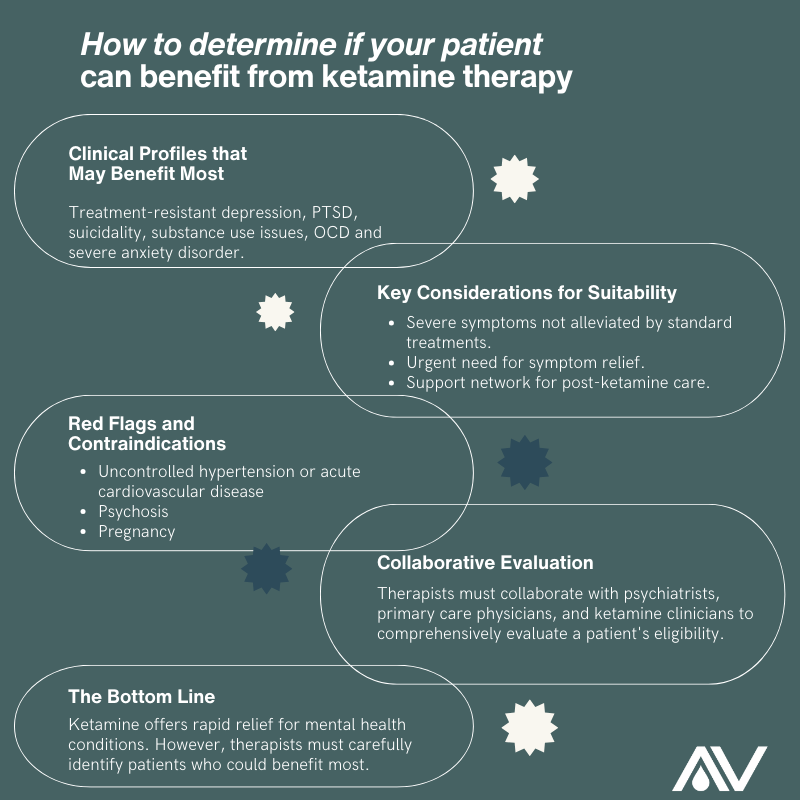
IV ketamine therapy is a powerful intervention for mental and physical health. However, not everyone is a good candidate for ketamine therapy. Therapists can identify ideal candidates by focusing on patients with treatment-resistant depression, PTSD, OCD, severe anxiety disorder, or acute suicidal ideation who have no contraindications such as severe physical health issues, ensuring they undergo a thorough psychiatric evaluation and possess a willingness to engage in a comprehensive treatment plan. This careful selection process aims to maximize therapeutic benefits while minimizing potential harm.
Important considerations
Generally, ketamine treatment is for people with severe mental illness who have tried other medications with little or no relief. Typically, this patient will have also attempted alternative therapies to no avail, such as TMS (transcranial magnetic stimulation), group therapy, or individual CBT (cognitive behavioral therapy).
However, ideal ketamine patients don’t always fall under a traditional “treatment-resistant” category. Some ideal candidates have not tried typical antidepressants and choose not to because of SSRIs’ potential inefficacy and side effects. Still, they are suffering from significant mental health issues and are well-informed about ketamine’s clinically studied, rapid benefits.
Practitioners should weigh these factors when determining ideal candidates for ketamine therapy
- The severity of symptoms: Ketamine is often successful for those dealing with significant depression and suicidal ideation. Therapists whose patients are suffering from extreme, hard-to-treat symptoms should consider educating them about ketamine.
- Duration of the current episode: A person dealing with depression for an extended time may be an ideal candidate for ketamine due to its ability to rapidly reduce depressive symptoms and suicidal thoughts by enhancing synaptic plasticity and promoting the growth of new neural connections.
- The urgency of treatment: Patients experiencing suicidal thoughts need immediate relief. Research shows ketamine can reduce suicidal thoughts within one day of a single IV dose, with benefits that can last at least one week.[1] The benefits may be more enduring for six-infusion protocols combined with psychotherapy.
- Availability of social support: Therapists must also consider whether the patient has friends or family to support them while undergoing treatment. Ketamine can alter how people think and feel, which can make them more sensitive to distress. Social support can buffer potential adverse effects, while lack of support could exacerbate them.
- Potential contraindications to ketamine: Therapists must rule out ketamine contraindications by carefully examining each patient’s medical history and refer patients to appropriate ketamine providers who can manage conditions such as heart disease and interactions with other medications. The sections below provide more information about potential contraindications.
Ideal clinical profiles for ketamine therapy

Substantial clinical data shows that patients experiencing treatment-resistant depression, suicidality, and severe PTSD may find meaningful relief from ketamine therapy.
- Depression: Ketamine is most widely studied in people with treatment-resistant depression.[2] The compound works in part by stimulating the release of glutamate, a major excitatory neurotransmitter. Glutamate promotes neuroplasticity, which can help “rewire” the brain to form new pathways that disrupt problematic thought patterns and make way for more productive perceptions and actions. Ketamine also works fast and may have fewer side effects than SSRIs for some patients.
- Suicidal thoughts: Ketamine is also well-studied for assuaging acute suicidality.[1] A study of patients with suicidal ideation found that a single ketamine dose rapidly reduced the severity of depression and improved thinking and reasoning within 24 hours, helping patients feel safer.[3]
- Severe PTSD: Clinical research supports ketamine as a promising option for PTSD, a disorder where standard treatment options often show limited efficacy.[4] Ketamine’s glutamate effects may help some of the most debilitating symptoms, such as intrusive thoughts, flashbacks, nightmares, and other forms of sensory overload.
Contact Avesta, with locations in Bethesda and Columbia, Maryland; Washington, DC; and Tysons (Vienna) and Norfolk, Virginia, to determine whether your patient is an ideal candidate for ketamine therapy.
Other patients that may benefit from ketamine
Research indicates ketamine may also help some patients with other mood and emotional disorders, including bipolar depression[5], generalized anxiety disorder, obsessive-compulsive disorder, and social anxiety disorder.[6]
However, clinical data is not as straightforward for these conditions as it is for ketamine’s benefits in depression, PTSD, and suicidality. For instance, ketamine’s mechanisms can in some cases be associated with a switch into a manic state, which may exacerbate hypomanic bipolar disorder symptoms.[7]
Therapists whose patients are suffering from these mood disorders should closely collaborate with the individual’s physicians and ketamine clinicians to determine an appropriate protocol.
Ketamine Contraindications and Red Flags
Patients may not be eligible for ketamine therapy if they:
- Are pregnant: Pregnant women are typically excluded from ketamine therapy due to the lack of research on the compound’s effects, posing potential developmental or maternal-fetal risks.
- Have uncontrolled hypertension or cardiovascular disease: Those with unmitigated hypertension or acute cardiovascular disease may not be ideal ketamine candidates due to the medicine’s known effects on blood pressure and heart rate.
- Have psychosis: Patients with psychosis might experience worsening of their symptoms due to ketamine’s psychoactive properties.
Uncontrolled medical conditions such as thyroid conditions, mental health histories, seizures, and drug interactions may also factor into ketamine suitability.
Contact Avesta, with locations in Bethesda and Columbia, Maryland; Washington, DC; and Tysons (Vienna) and Norfolk, Virginia, to determine whether your patient is an ideal candidate for ketamine therapy.
Is ketamine contraindicated in heart and thyroid conditions?

Ketamine can increase blood pressure, heart rate, and cardiac output, which can negatively affect those with a history of uncontrolled high blood pressure and other heart conditions. Patients with thyroid diseases that are not well controlled often already have an increased heart rate, which ketamine could exacerbate. Many clinicians recommend getting blood pressure or thyroid issues under control with medication before beginning ketamine treatments.
Is ketamine contraindicated in people with a history of psychosis or schizophrenia?

People with psychosis or a family history of the condition may not be ideal ketamine candidates, but the diagnosis doesn’t automatically make them ineligible. Ketamine’s dissociative, psychedelic-like effects mean a person can experience out-of-body sensations, which could worsen delusions and active hallucinations. People who have had adverse reactions to other dissociative anesthetics in the past could be at higher risk.
Still, ketamine for depression can be safe and effective in some patients with a history of psychosis or current symptoms.[8] These cases require that clinicians collaborate to determine the correct dosage and frequency of infusions, along with close patient monitoring.
Is ketamine contraindicated in seizures?
There is some conflicting data regarding the potential risk of seizures associated with ketamine. However, reports indicate that a rise in ketamine-related seizures is tied to illegal and recreational ketamine use, in which people may encounter a contaminated and potentially harmful version of the drug.[9] Some research suggests ketamine can be used in patients with epilepsy under appropriate medical supervision, though decisions here belong with the treating clinician.[10]
Is ketamine contraindicated with substance use histories?
Ketamine’s therapeutic indications may include treating addiction.[11] However, ketamine has a history as a party drug, which comes with abuse potential, especially for those with active issues. This risk is why therapists should never recommend at-home ketamine therapy.
Many clinics prescribe ketamine for remote use. However, a survey found that over half (55%) of respondents who tried this approach either accidentally or purposely used more than the recommended dose. The risk was even higher among younger patients.[12]
On the other hand, patients who receive monitored IV therapy may significantly benefit from ketamine.
Licensed clinical social worker Lisa Kays sometimes recommends ketamine for depressed patients with substance use issues, particularly those on SSRIs who have tried to quit but struggle with feeling terrible afterward, which often leads them back to the pattern. She suggests ketamine therapy can provide a “boost” for these individuals, making it easier to quit by alleviating the negative feelings associated with cessation.
Does ketamine negatively interact with other drugs?

Ketamine can have poor interactions with other drugs and medications.
- Central nervous system (CNS) depressants, such as opioids, benzodiazepines, and barbiturates, could exacerbate ketamine’s sedative effects.[13]
- Sympathomimetics, such as cocaine, amphetamines, and LSD, mimic or stimulate the adrenergic nervous system and can raise blood pressure.[13]
- Lamotrigine may reduce ketamine’s effects, and benzodiazepines tend to shorten the beneficial duration of ketamine on depression.[14]
- Antipsychotic medications, like haloperidol, risperidone, and clozapine, might interact with ketamine, though the quality of the evidence is still in question.[14]
Collaborative Evaluation and Referral Process

Assessing ideal candidates for ketamine therapy is often a collaborative process between the therapist, patient, prescribing physician, and ketamine clinicians.
Therapists who have any questions about whether ketamine is safe for their patients should contact established clinics, like Avesta, that offer in-house IV infusions or Spravato therapy.
Avesta’s practitioners regularly consult with social workers, therapists, psychiatrists, and physicians to determine whether patients can safely benefit from IV ketamine or Spravato. We also communicate with therapists throughout the protocol to answer questions and follow up on treatment outcomes.
Contact Avesta, with locations in Bethesda and Columbia, Maryland; Washington, DC; and Tysons (Vienna) and Norfolk, Virginia, to determine whether your patient is an ideal candidate for ketamine therapy.
References
- Grunebaum MF, Galfalvy HC, Choo TH, et al. “Ketamine for Rapid Reduction of Suicidal Thoughts in Major Depression: A Midazolam-Controlled Randomized Clinical Trial.” American Journal of Psychiatry, 2018;175(4):327–335. Accessed July 2026.
- Serafini G, Howland RH, Rovedi F, Girardi P, Amore M. “The Role of Ketamine in Treatment-Resistant Depression: A Systematic Review.” Current Neuropharmacology, 2014;12(5):444–461. Accessed July 2026.
- Keilp JG, Grunebaum MF, et al. “Ketamine and Neurocognition in Patients With Depression and Suicidal Ideation.” Journal of Clinical Psychiatry. Accessed July 2026.
- Feder A, Costi S, Rutter SB, et al. “A Randomized Controlled Trial of Repeated Ketamine Administration for Chronic Post-Traumatic Stress Disorder.” American Journal of Psychiatry, 2021;178(2):193–202. Accessed July 2026.
- Wilkowska A, Cubala WJ. “Ketamine in Bipolar Depression.” National Center for Biotechnology Information (PMC7670087). Accessed July 2026.
- Banov MD, Young JR, Dunn T, Szabo ST. “Efficacy and Safety of Ketamine in the Management of Anxiety and Anxiety Spectrum Disorders: A Review.” British Journal of Clinical Pharmacology, 2022. Accessed July 2026.
- Allen AN, Rodysill BR, et al. “A Report of Affective Switching Associated With Ketamine.” Case report. Accessed July 2026.
- Veraart JKE, Smith-Apeldoorn SY, Bakker IM, et al. “Ketamine Treatment for Depression in Patients With a History of Psychosis or Current Psychotic Symptoms: A Systematic Review.” Journal of Clinical Psychiatry, 2021. Accessed July 2026.
- NYU Langone Health. “Research Finds Major Increase in Seizures From Illegal Ketamine.” NYU Langone News. Accessed July 2026.
- Reddy CS, et al. “Ketamine Use in Patients With Epilepsy.” Heliyon / ScienceDirect, 2024. Accessed July 2026.
- Ezquerra-Romano II, Lawn W, Krupitsky E, Morgan CJA. “Ketamine for the Treatment of Addiction: Evidence and Potential Mechanisms.” Neuropharmacology, 2018;142:72–82. Accessed July 2026.
- Psychiatric Times. “Everything You Need to Know When Referring Patients to Ketamine Therapy Clinics.” Accessed July 2026.
- GoodRx Health. “Ketamine Interactions: What to Avoid.” Accessed July 2026.
- Veraart JKE, Smith-Apeldoorn SY, Trueman H, et al. “Pharmacodynamic Interactions Between Ketamine and Psychiatric Medications.” International Journal of Neuropsychopharmacology (PMC8538895), 2021. Accessed July 2026.