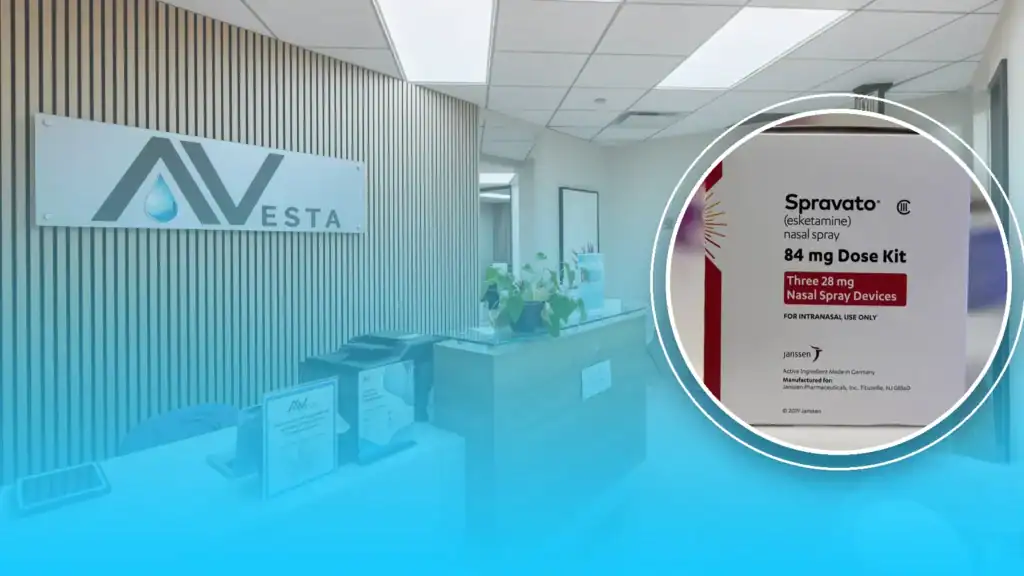
Spravato treatment is an FDA-approved esketamine nasal spray for adults with treatment-resistant depression or with depression and acute suicidal thoughts. Treatment-resistant means depression that has not responded to two or more antidepressants. You take each dose in a certified clinic, then stay at least two hours for monitoring. Our Spravato program offers it at all five clinics.
Key takeaways
- Spravato is FDA-approved for two adult uses: treatment-resistant depression, alone or with an oral antidepressant, and depressive symptoms with acute suicidal thoughts, alongside an oral antidepressant.
- Every dose happens in a certified clinic: you use the spray under observation, then stay at least two hours while staff monitor your blood pressure and breathing.
- Treatment follows a set schedule: twice a week for four weeks, weekly for the next four, then every one or two weeks based on your response.
- You cannot drive afterward: the label rules out driving until the next day, after a restful sleep, so you need a ride home from every session.
- Coverage is common but never automatic: as of October 2026, most of our patients with coverage pay $0 for the medication plus a $0 to $250 office visit.
What is Spravato?
Spravato is the brand name for esketamine, a prescription nasal spray approved by the U.S. Food and Drug Administration (FDA) to treat depression in adults. The FDA first approved it in March 2019, added a second use in July 2020, and approved it as a standalone treatment for treatment-resistant depression in January 2025.
Each device delivers 28 mg, and a session uses two or three devices for a dose of 56 mg or 84 mg. Your prescriber chooses the dose based on your response and tolerance.
Esketamine and ketamine are related but not the same
Ketamine is a mix of two mirror-image forms of the same molecule, called arketamine and esketamine. Spravato contains only esketamine. IV ketamine, which contains both forms, is used off-label for depression, meaning the FDA has not approved it for that purpose.
The two also differ in dosing, delivery, and coverage, which our guide to esketamine and racemic ketamine lays out.
Spravato is prescription-only and clinic-only
You cannot fill a Spravato prescription at a retail pharmacy and take it home. The medication goes only to certified healthcare settings, and it must never be dispensed directly to a patient for home use.
How does Spravato work?
Spravato works on glutamate, a chemical messenger that brain cells use to signal each other, rather than on serotonin like most oral antidepressants. Esketamine blocks a glutamate receptor called the NMDA receptor, but the FDA label states that the exact way it relieves depression is unknown.
What happens in the brain
Researchers have proposed several explanations. One leading hypothesis holds that blocking NMDA receptors sets off a short burst of activity at a second glutamate receptor, called AMPA. That burst may raise levels of brain-derived neurotrophic factor (BDNF), a protein that helps brain cells form new connections.
In plain terms, esketamine may help brain cells build new connections, a process called synaptic plasticity.
What researchers still do not know
No study has confirmed which of these effects matters most, or why one person responds and another does not. Your prescriber judges how Spravato is working by tracking your symptoms over the first weeks of treatment.
Who is Spravato treatment for?
Spravato treatment is for adults in one of the two groups named on the FDA label. The first group has treatment-resistant depression, meaning depression that has not responded to two or more antidepressants. The second group has major depressive disorder with acute suicidal thoughts or behavior.
Adults with treatment-resistant depression
For this group, Spravato can be used on its own or together with an oral antidepressant. Your prescriber decides which approach fits your history, your current medications, and how you tolerated past treatments.
If Spravato is not the right fit, our depression care team can also review IV ketamine and ketamine-assisted psychotherapy with you.
Adults with depression and acute suicidal thoughts
For this group, Spravato is always paired with an oral antidepressant and given twice a week for four weeks. It does not replace emergency care. If you or someone you love is in crisis right now, call or text 988 to reach the 988 Suicide and Crisis Lifeline.
Adults only
Spravato is not approved for anyone under 18. The label states that its safety and effectiveness in pediatric patients have not been established.
Who should not take Spravato?
You should not take Spravato if you have certain blood vessel conditions, a history of bleeding in the brain, or an allergy to esketamine or ketamine. Your prescriber also weighs several warnings, such as high blood pressure and pregnancy, before recommending it.
Conditions that rule out Spravato
The label lists four contraindications, which are conditions where the medication should not be used:
- Aneurysmal vascular disease: a weakened, bulging blood vessel in the brain, chest, abdomen, arms, or legs.
- Arteriovenous malformation: an abnormal tangle of connected arteries and veins.
- Intracerebral hemorrhage: any past bleeding inside the brain.
- Hypersensitivity: an allergy to esketamine, ketamine, or any other ingredient in the spray.
Warnings your prescriber reviews
Other conditions do not automatically rule you out, but each needs a careful look before your first dose:
- Elevated blood pressure: if your reading is above about 140/90 before a dose, your prescriber weighs the short-term rise against the expected benefit.
- Heart and brain blood-flow conditions: the label advises against dosing when a rise in blood pressure or pressure inside the skull would pose a serious risk.
- History of substance misuse: people with this history may face a higher risk of misusing esketamine.
- Pregnancy: Spravato may harm a developing baby, and the label does not recommend it during pregnancy.
- Bladder symptoms: the label includes a warning about bladder inflammation, known as ulcerative or interstitial cystitis.
How do you get prescribed Spravato?
To get prescribed Spravato, you need an evaluation by a prescriber, enrollment in the Spravato safety program, and treatment at a certified clinic. Most insurance plans also require prior authorization, which is advance approval from the plan. At Avesta, you do not need a referral to start.
The steps usually run in this order:
- Evaluation: a prescriber reviews your depression history, past medications, blood pressure, and other health conditions.
- Prescriber confirmation: if Spravato fits, the prescriber confirms which labeled use applies and whether you will take it alone or with an oral antidepressant.
- Safety program enrollment: you are enrolled in the Spravato REMS, the FDA-required safety program, before your first dose.
- Insurance approval: our team submits the prior authorization and checks your benefits before you commit to anything.
- First session: you start treatment in a REMS-certified clinic, which all five of our locations are.
What happens during a Spravato treatment session?
A Spravato treatment session lasts at least two hours from your dose to discharge. You use the spray yourself while a clinician watches, then rest while staff monitor your blood pressure and breathing. Most patients rest quietly, and some bring headphones because music helps them settle.
Before your session
Plan the whole visit, including the ride home, before you arrive. The label advises avoiding food for at least two hours before your dose and liquids for at least 30 minutes before. When you arrive, we check your blood pressure before the first spray.
During your session
You use each device yourself, with a five-minute rest between devices. Staff check your blood pressure again about 40 minutes after dosing. They also watch your breathing, including with a pulse oximeter, a small fingertip clip that measures your oxygen level.
The most common effect is dissociation, a temporary sense of detachment from your surroundings. In our clinics, it typically peaks around 40 minutes after the dose and fades within the monitoring window.
After your session
You leave once a clinician confirms you are stable, which is never sooner than two hours after dosing. You cannot drive or operate machinery until the next day, after a restful sleep. Someone needs to take you home, so plan for a quiet evening.
How long is Spravato treatment?
Spravato treatment for treatment-resistant depression starts with eight weeks of scheduled sessions, then continues at a pace your prescriber adjusts. There is no fixed end date; the goal is the least frequent schedule that keeps your response.
The FDA label sets this schedule for treatment-resistant depression:
| Phase | Weeks | How often | Dose per session |
|---|---|---|---|
| Induction | 1 to 4 | Twice a week | 56 mg or 84 mg |
| Maintenance | 5 to 8 | Once a week | 56 mg or 84 mg |
| Maintenance | 9 onward | Every one or two weeks | 56 mg or 84 mg |
For depression with acute suicidal thoughts, the label schedule is 84 mg twice a week for four weeks. Use beyond four weeks has not been systematically studied for that group.
How long people stay on Spravato varies. In a long-term trial, people who stopped Spravato after doing well were more likely to see symptoms return than people who continued it.
How effective is Spravato?
In clinical trials, Spravato reduced depression symptoms more than a placebo spray for adults with treatment-resistant depression, and continuing it lowered the chance of relapse. There is no single success rate, because each trial measured success differently. Spravato does not work for everyone, and individual results vary.
What the clinical trials found
Researchers usually track depression with the Montgomery-Åsberg Depression Rating Scale (MADRS), a 60-point clinician-rated scale where lower scores are better. Four results stand out:
- With a new oral antidepressant (2019): after 28 days, symptoms improved 4.0 points more on the MADRS than with the antidepressant plus a placebo spray.
- Relapse prevention (2019): among people in stable remission, 26.7% relapsed while continuing Spravato, compared with 45.3% of those switched to placebo.
- On its own (2025): at day 28, Spravato alone improved MADRS scores 5.1 to 6.8 points more than placebo, depending on the dose.
- Early change: in that same monotherapy trial, improvement over placebo appeared as early as 24 hours after the first dose.
These are average differences between groups, not a prediction for any one person.
How Spravato compares with other options
In a 2023 trial of 676 adults, 27.1% reached remission at eight weeks with Spravato, compared with 17.6% with extended-release quetiapine, another add-on medication. Remission meant symptoms dropped to a minimal level, a MADRS score of 10 or less.
No option is right for everyone, and our comparison of IV ketamine or Spravato sets dosing, onset, and coverage side by side.
Is Spravato safe?
Spravato is FDA-approved with strict safety rules because its short-term effects can be strong. The label carries a boxed warning, the FDA’s most serious type, for sedation, dissociation, breathing problems, misuse, and suicidal thoughts. Those risks are why every dose is given and monitored in a certified clinic.
Common side effects
In the main trials with an oral antidepressant, the most common side effects were these:
- Dissociation: 41% with Spravato, compared with 9% with placebo.
- Dizziness: 29% compared with 8%.
- Nausea: 28% compared with 9%.
- Sedation (sleepiness): 23% compared with 9%.
- Vertigo (a spinning sensation): 23% compared with 3%.
Most of these start shortly after the dose and ease the same day. In one trial, they generally resolved within 1.5 hours.
The REMS safety program
REMS stands for Risk Evaluation and Mitigation Strategy, a safety program the FDA requires for certain medications. Under the Spravato REMS, clinics and pharmacies must be certified, and patients must be enrolled before treatment. Every patient is watched by a healthcare provider for at least two hours after each dose.
Controlled substance status and misuse
Spravato is a Schedule III controlled substance under federal law. The label notes that physical dependence has been reported with long-term ketamine use, and that people with a history of substance misuse may face a higher risk.
Clinic-only dosing is a core safeguard, and it is why we do not offer or recommend at-home esketamine or ketamine nasal sprays.
How much does Spravato cost, and does insurance cover it?
As of October 2026, most of our patients with insurance pay $0 for the Spravato medication plus a $0 to $250 office visit per session. Without insurance, the medication runs $800 to $1,200 per session depending on dose, plus a $250 office visit.
The medication and the visit are billed separately. Three things set your cost: whether your plan covers the medication, whether it covers the in-clinic visit, and where you are in your deductible year.
These are the plans we are in-network with for Spravato, as of October 2026:
| Payer | Network status | Clinics |
|---|---|---|
| Aetna | In-network | All five |
| Cigna, including NALC | In-network | All five |
| VA | In-network, authorization required | All five |
| Workers’ Compensation | In-network, authorization required | All five |
| Maryland Medicaid, including UnitedHealthcare plans | In-network | Bethesda, Columbia |
| Virginia Medicaid (Anthem HealthKeepers or Aetna Better Health) | In-network | Tysons, Norfolk |
| Medicare | Out-of-network, all plans | None |
We handle the prior authorization for you. Our full pricing guide lists every treatment’s cost by plan. The insurance coverage page explains superbills and out-of-network claims. Aetna members can find plan details in our Aetna coverage guide, and veterans can start through VA Community Care.
Where can you get Spravato treatment in DC, Maryland, and Virginia?
We offer Spravato treatment at all five of our clinics, and each one is a REMS-certified setting. We have provided monitored, in-clinic ketamine care since 2018, under protocols set by Dr. Ladan Eshkevari.
Our five clinics:
- Washington, DC at 1400 16th St NW, Suite 101.
- Bethesda, Maryland at 4833 Rugby Ave, #400.
- Columbia, Maryland at 5840 Banneker Rd, Suite 270.
- Tysons, Virginia at 8000 Towers Crescent Dr, Suite A150, in Vienna.
- Norfolk, Virginia at 6275 E. Virginia Beach Blvd, Suite 103.
Current payers, prices, and booking details stay up to date on our Spravato treatment page.
If you want to find out whether Spravato fits your situation, book a free 30-minute consultation. No referral is needed, and we check your benefits before you commit to anything.